It is Finished {The Last Words of Jesus}

A daily devotional for the week before Easter, slowing down to consider each of the last words of Jesus from the Cross. #Lent #Easter #Devotional

Jesus’ last words in the book of John are perhaps the most famous of the last words of Christ: “It is finished.” What was finished? What did Jesus come to earth to accomplish?

I have come down from heaven, not to do My own will, but the will of Him who sent Me. This is the will of Him who sent Me, that of all that He has given Me I lose nothing, but raise it up on the last day. For this is the will of My Father, that everyone who beholds the Son and believes in Him will have eternal life, and I Myself will raise him up on the last day.”  (John 6:38—40)

And Jesus said, “For judgment I came into this world, so that those who do not see may see, and that those who see may become blind.”  (John 9:39)

The thief comes only to steal and kill and destroy; I came that they may have life, and have it abundantly. (John 10:10)

Now My soul has become troubled; and what shall I say, ‘Father, save Me from this hour’? But for this purpose I came to this hour. Father, glorify Your name.” Then a voice came out of heaven: “I have both glorified it, and will glorify it again.”  (John 12:27-28)

Jesus spoke these things; and lifting up His eyes to heaven, He said, “Father, the hour has come; glorify Your Son, that the Son may glorify You,  even as You gave Him authority over all flesh, that to all whom You have given Him, He may give eternal life. This is eternal life, that they may know You, the only true God, and Jesus Christ whom You have sent. 

 I glorified You on the earth, having accomplished the work which You have given Me to do. Now, Father, glorify Me together with Yourself, with the glory which I had with You before the world was. (John 17:1-5)


Jesus entered fully into the human experience.

He demonstrated the Father’s heart to an oppressed people, subjugated to a foreign government, and dying at the hands of the religious elite and the empire itself.

He fully accomplished His Father’s will, drinking even the cup of suffering and death.

He proved Himself the prophesied Messiah king, establishing the Kingdom of God, crowned on the Cross: King of the Jews.

He died, bringing abundant and eternal life. And this is eternal life, that they may know You, the only true God, and Jesus Christ whom You have sent.

He glorified His Father.

It is finished.


“It is finished” are perhaps the most familiar and frequently preached about of Christ’s last words. We know that the work of Jesus was fully completed on the cross. And yet we so often tend toward living a Jesus and… life. “Jesus gave me abundant and eternal life, and also I have to….” Are there things we need to do in addition to what Jesus did on the cross? Why or why not?


Lord Jesus, we hear your words, “It is finished.” We believe you entered fully and completely into our human experience—Emmanuel, God with us—and you fully and completely accomplished the Father’s will. Help me to sit in the silence of your “It is finished.”


Every day between now and Good Friday, come back here to find a devotional on one of the last statements of Jesus from the cross, as well as an invitation to slow down and meet Jesus at the foot of the cross.

I’ve compiled all of these posts into a PDF for my subscribers. If you’d like a copy of that, you can sign up here.


My God, My God, Why Have You Forsaken Me? {The Last Words of Jesus}

A daily devotional for the week before Easter, slowing down to consider each of the last words of Jesus from the Cross. #Lent #Easter #Devotional

When have you experienced darkness, a time where you felt that God was far from you? When have you felt the most abandoned?


After 3 hours of darkness, Jesus cries these words of despair, quoting Psalm 22. The Psalm continues,

Far from my deliverance are the words of my groaning. O my God, I cry by day, but You do not answer; And by night, but I have no rest. Yet You are holy…”

Theologians debate the significance of this moment and argue about what Jesus intended to communicate by quoting this particular Psalm. But at its simplest, most basic level, we can see this moment as Jesus entering fully into our human condition.

Born into a broken, hurting world, sin eclipses the sun. We feel forsaken, alone, and hell comes in close.

Darkness falls, we feel we don’t deserve God’s love, we’ve turned away from His presence and goodness: Might we meet Jesus, even here?


If I say, “Surely the darkness will overwhelm me, And the light around me will be night,” even the darkness is not dark to You, and the night is as bright as the day. Darkness and light are alike to You. (Psalm 139:11-12)


Picture yourself at your darkest hour: Your hardest trial, your greatest failure, your most alone. Now picture Jesus, meeting you there. Can you see the grace in His eyes?


Every day between now and Good Friday, come back here to find a devotional on one of the last statements of Jesus from the cross, as well as an invitation to slow down and meet Jesus at the foot of the cross.

I’ve compiled all of these posts into a PDF for my subscribers. If you’d like a copy of that, you can sign up here.
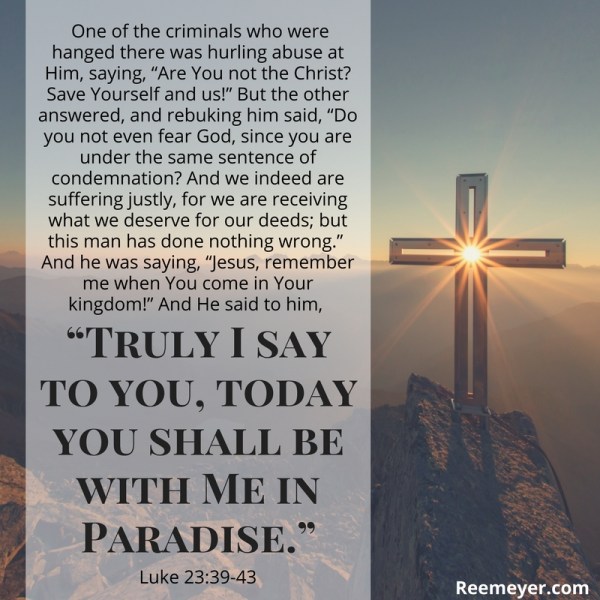
 

Woman, Behold Your Son {The Last Words of Jesus}

A daily devotional for the week before Easter, slowing down to consider each of the last words of Jesus from the Cross. #Lent #Easter #Devotional

Sometimes it’s easier to serve the poor and be generous with strangers than it is to be kind to my own family.

Is God pleased when I stand up for the oppressed, then turn around and belittle or yell at my children? Does it honor God when I bring an audience of hundreds to praise and tears, but neglect my mother, lonely in her empty nest?

I can blame ignoring the needs of those closest to me on my devotion, my commitment to the gospel, my care for the world. But that attitude is revealed for the lie it is, here in the eyes of Christ. Even in pain, even in death, there is no conflict between His obligation to His family and His Father’s will and plan.

In Jesus’ care for His mother in these last minutes of His life, I see the heart of a son, a good and loving son. And I see the heart of God.

Pure and undefiled religion in the sight of our God and Father is this: to visit orphans and widows in their distress, and to keep oneself unstained by the world. (James 1:27)


When have you been tempted to use religious obligation or the need to do “good things” as an excuse to neglect caring for those closest to you (things for which there is no applause or even thanks)?


Orphans and widows were the 2 of the most vulnerable populations in New Testament times, people for whom there was no societal safety net. Think about the vulnerable people in your own neighborhood or city, people for whom there is no safety net. What could you do to care for vulnerable people this week, in Jesus name?


Every day between now and Good Friday, come back here to find a devotional on one of the last statements of Jesus from the cross, as well as an invitation to slow down and meet Jesus at the foot of the cross.

I’ve compiled all of these posts into a PDF for my subscribers. If you’d like a copy of that, you can sign up here.
 

Truly I say to you, today you will be with Me in Paradise {The Last Words of Jesus}

A daily devotional for the week before Easter, slowing down to consider each of the last words of Jesus from the Cross. #Lent #Easter #Devotional

Which is harder for you, forgiving others or being forgiven? Why?


As I read Jesus’ words of Grace to the criminal dying next to Him, I am reminded of His forgiveness of ME. Am I that different from a thief, really? I steal God’s glory, I trade my own value and worth for a bowl of soup, I ignore the face of God in my brother.

All of us like sheep have gone astray, Each of us has turned to his own way; But the Lord has caused the iniquity of us all To fall on Him. (Isaiah 53:6)

As I see and receive the grace and forgiveness of Jesus with the thief on the cross, I’m reminded that our Lord died the way He lived: With arms opened wide to the downcast, the sinners, the breaking and broken in this world.


I let my to do list, my social media, my overstuffed schedule, distract me from hurting people, from the business of God’s Kingdom. And here is Jesus, even as He suffers and dies, seeing the hurting ones around Him, responding in grace.


Lord Jesus, I see You. I see your arms open wide, and I hear your invitation to follow You in a life lived wide open, available to the hurt and hurting, even to death. Meet me here, Jesus, and change my heart to look more like yours.


Every day between now and Good Friday, come back here to find a devotional on one of the last statements of Jesus from the cross, as well as an invitation to slow down and meet Jesus at the foot of the cross.

I’ve compiled all of these posts into a PDF for my subscribers. If you’d like a copy of that, you can sign up here.

 

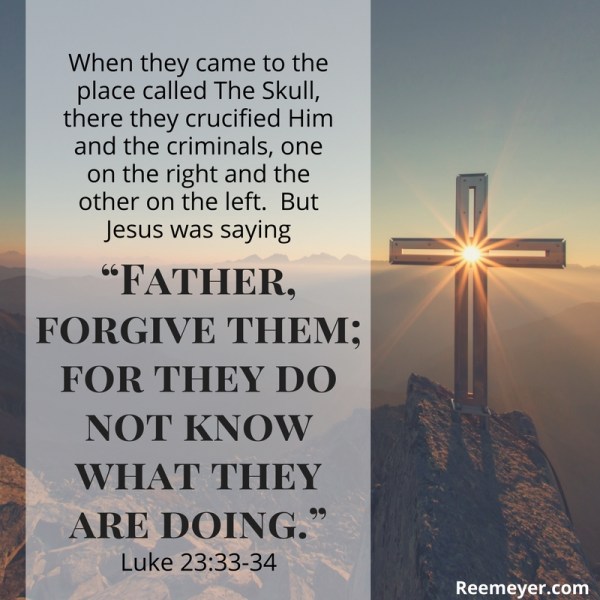
Father, forgive them, for they don’t know what they’re doing {The Last Words of Jesus}

A daily devotional for the week before Easter, slowing down to consider each of the last words of Jesus from the Cross. #Lent #Easter #Devotional

Back raw with the wounds of scourging, face dripping blood from the crown of thorns, with spikes in His hands and feet, Jesus cries,

FATHER, FORGIVE THEM…

Jesus is living out God’s teaching: Love your enemies. Pray for those who persecute you.

Jesus is demonstrating God’s heart. It looks to me like His enemies know exactly what they’re doing: They set Him up, they trapped Him, they rejoice even as He suffers, mocking Him.

And He says, “They do not know what they are doing…”

Picture yourself, standing at the foot of the cross on that dark day, a friend of Jesus, grieving what has been done to Him. How do you feel, hearing Him cry forgiveness? Can you forgive those who put Him here, believing they don’t know what they’re doing?

Does it help you to forgive them, knowing Jesus’ forgiveness includes you, too? We lash out at goodness, hating ourselves, hurting others. Crucifying, over and over. We don’t know what we’re doing.


Can I extend this same grace to my enemies, or even to those who simply annoy  and inconvenience me? When wronged, can I pray, “Father, forgive them?” Even in the face of human calculating, deceit, harm, can I see a bigger picture, “They don’t understand what they’re doing”?

Take a moment and think of someone who has wronged you, maybe even someone you would consider an enemy. Ask Jesus to join you in your thoughts and memories of this person. Picture the look in His eyes. Are they included in His forgiveness? In yours?


Every day between now and Good Friday, come back here to find a devotional on one of the last statements of Jesus from the cross, as well as an invitation to slow down and meet Jesus at the foot of the cross.

I’ve compiled all of these posts into a PDF for my subscribers. If you’d like a copy of that, you can sign up here.


Holy Week: The Words of Jesus on the Cross

As we head into this week in the church calendar set aside to remember the death of Jesus, I want to SLOW DOWN. I don’t want to rush past Good Friday, anxious to move beyond the uncomfortable story of Jesus’ death in order to celebrate the Resurrection.

Why? Because Jesus came to this earth and called people just like me to follow Him. I follow a risen savior, conqueror of death and hell. But the road He’s called me to follow Him on is a road lined with pain, suffering, humiliation. His road is the road to the cross.

We walk the road of life, grieving the pain and suffering in this fallen world, seeing humiliation and oppression around the world and in our own neighborhoods, sure to experience death ourselves.

Perhaps we need the example, the encouragement, the words of Jesus? Perhaps we could meet Him here?

Join me this week and slow down with Jesus, looking each day at one of the things He said in His last hours from the cross at Golgotha, expecting Him to meet us here.

Set aside time over the next 6 days to meditate on each of the last words of Jesus on the cross. Every day between tomorrow (Palm Sunday) and Friday, I’ll share one of the last statements of Christ on the cross, along with reflection questions and brief devotional thoughts.

Tomorrow we we begin prayerfully considering each statement Jesus cried as He finished the work our Father sent Him to accomplish. Today we remember the path that led Jesus to the cross.

After sharing a Passover meal with His dearest friends, our Lord was betrayed into the hands of His enemies, arrested, and brought before the Roman Governor.

Early in the morning the chief priests with the elders and scribes and the whole Council, immediately held a consultation; and binding Jesus, they led Him away and delivered Him to Pilate. 2 Pilate questioned Him, “Are You the King of the Jews?” And He *answered him, “It is as you say.” 3 The chief priests began to accuse Him harshly. 4 Then Pilate questioned Him again, saying, “Do You not answer? See how many charges they bring against You!” 5 But Jesus made no further answer; so Pilate was amazed.

6 Now at the feast he used to release for them any one prisoner whom they requested. 7 The man named Barabbas had been imprisoned with the insurrectionists who had committed murder in the insurrection. 8 The crowd went up and began asking him to do as he had been accustomed to do for them. 9 Pilate answered them, saying, “Do you want me to release for you the King of the Jews?” 10 For he was aware that the chief priests had handed Him over because of envy. 11 But the chief priests stirred up the crowd to ask him to release Barabbas for them instead.12 Answering again, Pilate said to them, “Then what shall I do with Him whom you call the King of the Jews?” 13 They shouted back, “Crucify Him!” 14 But Pilate said to them, “Why, what evil has He done?” But they shouted all the more, “Crucify Him!” 15 Wishing to satisfy the crowd, Pilate released Barabbas for them, and after having Jesus scourged, he handed Him over to be crucified.

16 The soldiers took Him away into the palace (that is, the Praetorium), and they *called together the whole Roman cohort. 17 They dressed Him up in purple, and after twisting a crown of thorns, they put it on Him; 18 and they began to acclaim Him, “Hail, King of the Jews!” 19 They kept beating His head with a reed, and spitting on Him, and kneeling and bowing before Him. 20 After they had mocked Him, they took the purple robe off Him and put His own garments on Him. And they *led Him out to crucify Him.

21 They pressed into service a passer-by coming from the country, Simon of Cyrene (the father of Alexander and Rufus), to bear His cross.

22 Then they brought Him to the place Golgotha, which is translated, Place of a Skull. 23 They tried to give Him wine mixed with myrrh; but He did not take it. 24 And they crucified Him, and divided up His garments among themselves, casting lots for them to decide what each man should take. 25 It was the third hour when they crucified Him. 26 The inscription of the charge against Him read, “THE KING OF THE JEWS.”

(Mark 15, NASB)


Why did Jesus’ life end in gruesome, painful death?

The Sunday School answer is “He died for my sins.” This is true, and beautiful, but paying a penalty for sins is not the only thing Jesus accomplished on the Cross.

What else do you think Jesus was doing for you and for the world on the cross?


If you had to explain what the death of Christ means to you to someone who didn’t know anything about it, what would you say?


Every day between now and Good Friday, come back here to find a devotional on one of the last statements of Jesus from the cross, as well as an invitation to slow down and meet Jesus at the foot of the cross.

I’ve compiled all of these posts into a PDF for my subscribers. If you’d like a copy of that, you can sign up here.
 

The Last One chosen for the Team and Other Childhood Trauma {No Fear Devotional}

From my distress I called upon the LordThe Lord answered me and set me in a large place.
The Lord is for me; I will not fear; What can man do to me?
The Lord is for me among those who help me; Therefore I will look with satisfaction on those who hate me.
It is better to take refuge in the Lord Than to trust in man.
It is better to take refuge in the Lord Than to trust in princes. (Psalm 118:5-9)

My grade school days taught me a life-long aversion to picking teams. There isn’t any situation in a standard PE curriculum for which I wouldn’t be the last one picked for the team. (Too bad we never chose teams for reading. Or making up stories. Or bossing around younger siblings.)

Through the years I’ve found myself in job searches which stirred up that “please pick me” feeling again. Is there anyone in the world who enjoys interviewing, attempting to sell themselves as the best candidate for a job?

In my pre-marriage days, I loved the independence singleness offered, along with the freedom to be fully available to friendships and serving my community. I did not love situations that required a partner, highlighting my “table of one” status, making me feel like the last kid chosen for the team, again.

Surely no one likes feeling unwanted, like the last one chosen?

As human as these feelings are, they are also a danger zone for me, leading as they do into the fear of man. My desire to be chosen quickly escalates into idolatry of the person in charge of choosing. I am easily fooled into giving human beings rights to my heart that belong to God alone.

I walk into a room, and feel like people are talking about me. I wonder if they like me, if anyone here wants to be my friend.

I watch a co-worker, whose areas of excellence overlap with my own, succeed. Rather than celebrating her success, I’m suddenly stuck on the sidelines, while she is chosen to play in the big game.

At work, decisions are being made that could affect my future. I feel threatened, attacked, unappreciated. I am convinced that my future and well-being are in the hands of people who care nothing for me.

I really wish life did not include so many situations that tempt me to believe that my value, my worth, my future, were things that other people get to decide for me.

What if these minor annoyances and major struggles are actually opportunities? Here I find a chance to live in the belief that I am not at all the last one standing, but in fact “chosen and dearly loved” (Colossians 3:12).

Here I find an occasion for turning from my fear of man, taking back the right to name me as wanted, chosen, valued, protecting that privilege for my Maker God alone. God is FOR me.

In every situation that sends me back to that PE gym, feeling unchosen, unwanted, not good enough, I find the possibility to choose trusting God rather than trusting in man.

Pushed to the wall, I called to Godfrom the wide open spaces, he answered.
God’s now at my side and I’m not afraid; who would dare lay a hand on me?
God’s my strong champion; I flick off my enemies like flies.
Far better to take refuge in God than trust in people;
Far better to take refuge in God than trust in celebrities.

(Psalm 118:5-9, The Message)

How about you? What makes you feel unwanted, unchosen? Do you find yourself trusting in human help, human favor, human solutions to your problems?

Be encouraged: The beautiful NO FEAR promise in Psalm 118 is bookended by an even more beautiful promise. Psalm 118 begins and ends with the words:

Give thanks to the Lord, for He is good;
For His lovingkindness is everlasting.

The good Lord, full of everlasting lovingkindness, is for me. And for you. We will not fear.

This post is the latest in the NO FEAR Devotional Series. Check back every Tuesday, and read the previous posts in the series here. And If this resonated with you, feel free to share it using the link below: That really helps people to find this site, which hopefully will bless them as it has blessed you!

Picture used in image is by Kyle Fang on Unsplash

Fear + Enemies

There may not be any area in my life where I need to hear the Father's "Do not be afraid" more than in the context of loving my enemies and facing the violence in our world. Perhaps if I received the Father's "Do not fear", I'd be less likely to see people as my enemy. Perhaps I'd be more likely to look to God, who is my defense and help

I’m determined to continue studying the Biblical command “Do not fear,” but I’ve run into a road block. A mind block. Six books into the Bible (beginning with Joshua), and I’m only finding verses where the context of “do not fear” is enemies.

Now the Lord said to Joshua, “Do not fear or be dismayed. Take all the people of war with you and arise, go up to Ai; see, I have given into your hand the king of Ai, his people, his city, and his land. (Joshua 8:1)

“Be strong and courageous, do not fear or be dismayed because of the king of Assyria nor because of all the horde that is with him; for the one with us is greater than the one with him. (2 Chronicles 32:7)

When I saw their fear, I rose and spoke to the nobles, the officials and the rest of the people: “Do not be afraid of them; remember the Lord who is great and awesome, and fight for your brothers, your sons, your daughters, your wives and your houses.” (Nehemiah 4:14)

Battle, conquest, even the wholesale slaughter of people groups as Israel takes and keeps the promised land. These stories need more context than I have the time to present.

But more importantly, I find myself in a world where culture and even the church regularly tells me who my enemies are: Whom I should hate, who I am against, who is evil and with whom we should do battle.

I believe the Bible is God’s Word and we should be guided by it. But I’m not sure I want ancient cultures naming enemies for me, or prescribing my response to the enemies I might have. I have to follow Jesus in these things, and He leads in a different way.

And frankly, in a week when I’ve had to take a break from the news, from the sound of gunshots in schools and deep divisions over how we can curb the violence breaking out among us, I don’t want a Bible study that is centered on war and naming people as my enemies.

Read more

What Do We Do With Our Negative Emotions? {Desperate: A Devotional on Psalm 42}

What do we do with our negative emotions? Psalm 42 teaches us to run, desperately to God with our anger, fear, confusion, disappointment. And to say to our souls: Hope in God.

As the deer pants for the water brooks, So my soul pants for You, O God.
My soul thirsts for God, for the living God; When shall I come and appear before God? (Psalm 42:1-2)

I’ve sung these words as a lullaby over each of my babies, and you can find sweet, peaceful prints of these words in any Christian store. A sweet fawn tenderly approaching a quiet stream: Lovely.

But that’s not the picture the psalmist is painting. Psalm 42:1 is a picture of desperation.

Joel 1:20 uses the word “pant” to describe animals when the brooks are dried up and the pastures are devoured by fire. Maybe a better translation is:

“As a hunted deer, dying of thirst, pants for water, so my soul longs for You, O God.”

It doesn’t work quite as well for a lullaby or home decor, but I personally need to know that there’s a place for desperation in the life of the faithful.

Whether we like to talk about it or not, we all have negative emotions. Sorrow, grief, disappointment, confusion, anger: At ourselves, at each other, at our circumstances, at God.

And we have a choice: We can ignore these negative emotions. We can bully and bury them with truth. We can eat them to death, drug them, numb them, run far far away from them. We can be so busy we never have to face them. We can settle for living with them, that these negative emotions are all we have, always. We can complain about the reasons for them.

Or we can let them drive us, desperate, to God.

The root sin of humanity is the desire to be God, to live independently from God.

What if the hardships that come from living in this fallen world can help save us from that independence? What if we let those things drive us, desperate, to God?

This is the great lesson of the lament Psalms. Honest, specific, even poetic descriptions of the hardships of life on this earth. The psalmists take their complaints, their disappointments, their grief, confusion, and anger straight to God. And they included these conversations with God in their public worship, coming together to affirm their desperate need for God. Saying together,

Why are you in despair, O my soul? And why have you become disturbed within me? Hope in God, for I shall yet praise Him, The help of my countenance and my God. (Psalm 42:11)

What would it look like for you to allow room for negative emotions, in yourself and others?

What would it look like to bring your hard things to God, and wait in the tension between what God says is true of and for us and our circumstances, our felt experiences?

This world is a hurting, broken place. Things are not as they should be, in the world or in the church among God’s people. Things are not as they should be in our own homes and families.

Whether we realize it or not, we are desperately in need of God, the living God.

And now, Lord, for what do we wait? Our hope is in you.

What do we do with our negative emotions? Psalm 42 teaches us to run, desperately to God with our anger, fear, confusion, disappointment. And to say to our souls: Hope in God.


Image used in Photo by Robert Zunikoff on Unsplash


Eating Obstacles for Breakfast (No Fear)

Are you facing challenges that make you feel like a grasshopper? Look to Joshua and Caleb and learn to eat those obstacles for breakfast. (No Fear Devotional from reemeyer.com)

Our No Fear study this week continues the story of Moses and the Isrealites, who saw the Lord fight for them, while they had only to be still. After crossing the Red Sea and experiencing the deliverance of the Lord, the Hebrews were ready to enter the land God promised Abraham generations before.

Standing at the brink of God’s promises, at the border of Canaan, the people decide to send 12 spies into the land, to prepare the nation for the battle ahead.

Ten spies return with terrible news:

They gave out to the sons of Israel a bad report of the land which they had spied out, saying, “The land through which we have gone, in spying it out, is a land that devours its inhabitants; and all the people whom we saw in it are men of great size… and we became like grasshoppers in our own sight, and so we were in their sight.  (Numbers 13: 32-33)

This report causes the people to despair. But there is a voice of hope. Two of the spies have an entirely different view of the land of promise.

Caleb and Joshua attempt to calm the people, assuring Moses that the people can indeed take the land as God has promised. As the people weep and wail, wishing they had died in Egypt, Joshua and Caleb beg the people to believe God’s promise.

This fascinates me: How can 12 people have the exact same experience and come to two entirely different conclusions?

The answer is perspective.

Ten spies see obstacles, barriers, giants. Their view of the obstacles is bigger than their view of God: And so they preach fear and fleeing.

Joshua and Caleb see the obstacles, but their view of God is bigger than anything they saw in the land. And so they preach faith. Hope. Trust.

Joshua the son of Nun and Caleb the son of Jephunneh, of those who had spied out the land, tore their clothes;  and they spoke to all the congregation of the sons of Israel, saying, “The land which we passed through to spy out is an exceedingly good land.  If the Lord is pleased with us, then He will bring us into this land and give it to us—a land which flows with milk and honey. Only do not rebel against the Lord; and do not fear the people of the land, for they will be our prey. Their protection has been removed from them, and the Lord is with us; do not fear them.” (Numbers 14:6-9)

Ten spies see giants. Joshua and Caleb see food, knowing that the obstacles we face by faith strengthen us.

Perspective is a choice.

What choice will we make? As we look to the unknown, to challenges, as we listen to the voices in our heads that cry “I CAN’T”, which is bigger? The challenge? The obstacle? The giants?

Or God?

Perspective is largely a function of focus. In photography, whatever is closest to the camera appears largest. I have a choice where I focus, and what I let be closest to me, as I picture challenges and things that make me afraid.

Is the challenge, the source of fear, standing between me and God?

Or am I looking at every challenge – like Joshua and Caleb – through the lens of a good God, who keeps His promises?

This is an important choice: It will lead us to be grasshoppers in our own eyes, or it will allow us to see obstacles as food for us. And if we’re leaders? It’s the difference between leading people to despair or encouraging them to faith. God WILL keep His promises. No fear.


Journaling Prompts:

What obstacles are you facing right now? What makes you feel like a grasshopper, and maybe like you’d be better off anywhere but here?

As a leader (in life, in your job, in your family), in what ways might you tend to focus on challenges and obstacles, letting them be bigger than God in your eyes and the eyes of those you lead? And how are you encouraged in your leadership by Caleb and Joshua’s example?

As you look to the future, things that make you feel fearful, what would it look like for you to see God as bigger than any obstacle or challenge?

Are you facing challenges that make you feel like a grasshopper? Look to Joshua and Caleb and learn to eat those obstacles for breakfast. (No Fear Devotional from reemeyer.com)


This post is the latest in the NO FEAR Devotional Series. If this resonated with you, check back every Tuesday, and read the previous posts in the series here.


Photo in cover images by Gouthaman Raveendran and Boris Smokrovic on Unsplash