On Knowing When to Speak and When to Be Silent

I have a voice.

Sometimes it can be loud, and I hate being shushed. My voice is one of the things that makes me feel like I am too much for people. Being loud makes me feel like I’m not feminine or soft or “Christian womanly” enough.

I have a voice.

Because of my life, job, different opportunities and even my (sometimes too loud for people) personality, people listen to me.

I have a voice, and I am not afraid to use it.

I want to speak up for the oppressed. I want to draw out the silenced. I want to encourage the discouraged, speak truth into lies, speak life and value over myself, my family, those close to me, and anyone who crosses my path.

I have a voice.

But sometimes I feel silenced. It can feel like a woman has to speak louder than is socially acceptable in order to be heard, and I don’t want to be “that woman.” It feels like my little words have no impact on the lies and fighting and noise in the world. Even in prayer, it can feel like what I want, what I’m asking God to do in my life and in this hurting and broken world, are just words thrown to the wind.

Faith is a necessary element to Christianity. But faith in what? I want to grow in faith that God hears me.

And as I grow in certainty that He hears me, I want to grow in claiming Him as my first audience. I want to go first  to Him with my fears, concerns, joys, and worries. Before I let something rattle around in my head for days and weeks, before I pour out complaints and fears to a friend, before I share a praise or celebration online, I want God to hear my voice.

Give ear to my words, O LordConsider my groaning.
Heed the sound of my cry for help, my King and my God, For to You I pray.
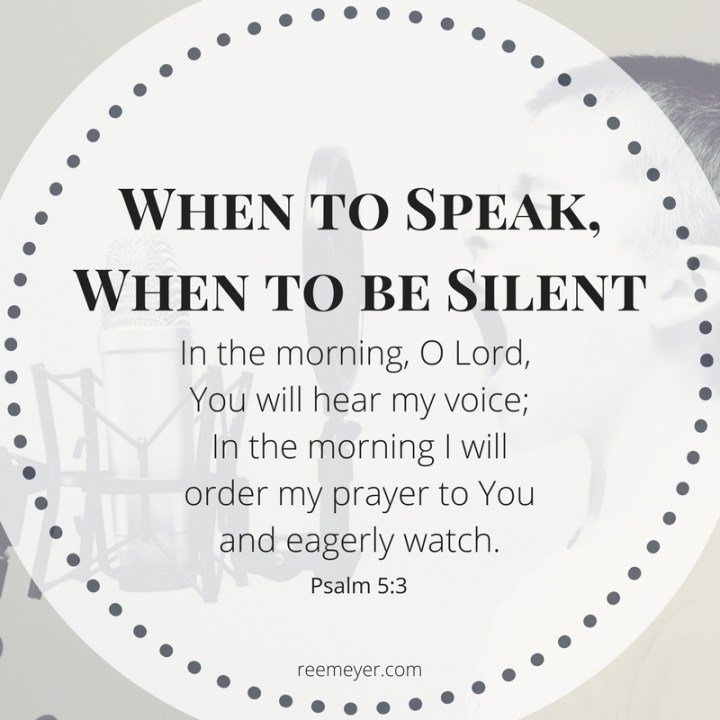
In the morning, O Lord, You will hear my voice;
In the morning I will order my prayer to You and eagerly watch.

Psalm 5: 1-3 (NASB)

In a world that is loud, how do we practice silence? How do we avoid contributing to the noise and strife and outrage-fueled peaceless-ness?

In a world that silences us, how do we learn to speak up? To claim our right to consent, own our own preferences, opinions, feelings? How do we claim our right to speak in a world that doesn’t want to hear our voice?

Perhaps this is a purpose for prayer, a reason why we pray.

Not to get what we want, not for answers, but to teach us.

Perhaps prayer is a place where we can practice believing we are heard.

Perhaps if I submit my voice to God first, I will gain confidence in being heard, valued, loved by my heavenly Father.

And perhaps then I will learn when to speak, and when to be silent.

I love the Lord, because He hears My voice and my supplications.
Because He has inclined His ear to me, Therefore I shall call upon Him as long as I live.

Psalm 116:1-2 (NASB)

When to Speak, When to be Silent quote (1)

Photo in my images is by Jason Rosewell on Unsplash

The Journey from People-pleasing to God-pleasing (a review of UNSEEN: The Gift of Being Hidden in a World that Loves to Be Noticed, by Sara Hagerty)

My whole life I’ve cared more about what people think of me than is healthy or helpful. Image management has been my mode as long as I can remember, and I have a pattern of caring more about reputation than I do about reality. In my first days learning to follow Jesus I began to realize how this focus on externals and others’ opinions can infect my faith just as it infects every other relationship and activity.

I write about Jesus, I teach people about Jesus, it is my job to talk to college women about Jesus, weekly and even daily. In these things, I have to keep vigilant watch over my tendency to care more about the outside than the inside. I am called to live my faith out in the open where people can see and invite others to join me, but I need to be very careful that I’m actually living my life with Jesus rather than just talking about Him.

If my first priority is what I can see, what others can see and comment on and measure, I easily lose sight of the things that last, the things that matter, the things God cares about most. I easily lose sight of my heart, which only God truly sees and knows. Matthew 6 teaches me that if my audience is the world, then the praise of the world is the most I’ll ever get. But if God is my first audience, then I get His reward, His notice, His praise.

“Be especially careful when you are trying to be good so that you don’t make a performance out of it. It might be good theater, but the God who made you won’t be applauding… Here’s what I want you to do: Find a quiet, secluded place so you won’t be tempted to role-play before God. Just be there as simply and honestly as you can manage. The focus will shift from you to God, and you will begin to sense his grace. Matthew 6:1, 6 (The Message)

I have grown hungry to protect out part of my relationship with Jesus for just me and Him. And I’ve prayed and thought and worked to focus and prioritize and value the things I can’t see over what I can see, touch and measure (hence the name of my blog.)

Over the last year in particular I’ve been seeking hidden places, asking God to meet me in ways I don’t share, that aren’t for public consumption.

Imagine my joy when I learned that one of my favorite writers, a fellow blogger and adoptive parent who has consistently pointed me to Jesus, had a new book coming out called, UNSEEN: The Gift of Being Hidden in a World That Loves to Be Noticed. Read more

Sometimes Loving Your Neighbor Means Speaking Up & Doing Something {The Call of Jesus}

On Tuesday I shared a devotional on what it means to love your neighbor. I wrote many of those thoughts nearly a year ago, and it was my plan all summer to be posting about this particular topic this particular week.

I had no idea I’d spend this particular week seeing Jesus’ call to love our neighbor misquoted and misused so frequently. My social media feeds have seen quite a lot of push back this week to the outpouring of condemnation of the white supremacy and racism expressed in Charlottesville, NC over the weekend.

Listen, white pride rallies in 2017 are a lot to process. I get that. It was shocking and surprising to a lot of people (not many people of color, I’m guessing?) I was dismayed at the outbreak of violence, I was glad to see so many Christian friends calling the rally what it is (racism and a travesty of the Biblical understanding of each person made in God’s image), I was sad that Charlottesville was not mentioned or prayed about in my church on Sunday morning.

But what surprised me was the stream of friends and commenters, over the course of the week, saying that those who are speaking up against things like Charlottesville are part of the problem. I was surprised to hear that what we really need to do is shut up and love our neighbors.

Y’all, sometimes loving our neighbors means speaking up when someone is propagating hate against them.
Read more

Love Your Neighbor As Yourself: A Devotional on the Great Commandment {The Call of Jesus}


 “A man was going down from Jerusalem to Jericho, and fell among robbers, and they stripped him and beat him, and went away leaving him half dead.  And by chance a priest was going down on that road, and when he saw him, he passed by on the other side.  Likewise a Levite also, when he came to the place and saw him, passed by on the other side.  But a Samaritan, who was on a journey, came upon him; and when he saw him, he felt compassion, and came to him and bandaged up his wounds, pouring oil and wine on them; and he put him on his own beast, and brought him to an inn and took care of him.  On the next day he took out two denarii and gave them to the innkeeper and said, ‘Take care of him; and whatever more you spend, when I return I will repay you.’  Which of these three do you think proved to be a neighbor to the man who fell into the robbers’ hands?”  And he said, “The one who showed mercy toward him.” Then Jesus said to him, “Go and do the same.” (Luke 10:30-37)

Which of the characters in this story do you identify with most?

The traveler left for dead, truly in need of a neighbor? The robbers who chose their own well-being at the expense of a fellow human? The priest and Levite, who prioritized their religious obligations and expectations over the needs of another? Or the Samaritan, the political outsider, shunned and avoided, who perhaps needed compassion himself, and so was able to extend it to another? Read more

A Prayer for Peace {Psalm 122}

Last year our college ministry spent the summer in the Psalms, and our staff directional team took turns writing devotionals for each Psalm that we covered. While I am traveling and working on some long term projects this summer, I thought I’d share some of the devotionals I wrote. Today’s is on Psalm 122, which you can read here.

Imagine you are one of the children of Israel, in the generations after exile.

You were born of a people covenanted to Yahweh God, married to the Most High. Your ancestors followed Yahweh out of Egypt, through the wilderness and into the land of promise – Israel. You grew up listening to stories of the golden years – when Israel was united under King David and worship centered around the temple in Jerusalem. Jerusalem, named the city or fountain of shalom (peace, wholeness,  flourishing.) But along with those golden stories, you also grew up with stories of darkness, consequences, judgment. Your ancestors, your people, were unfaithful to Yahweh. They joined themselves to other gods, sought protection through military might and treaties with foreign nations rather than in Yahweh your God. And so – as was promised in the ancient texts, and warned of by prophet after prophet, the mighty men of old – your people were removed from the land. Carried off by the very foreign powers they had looked to for safety and security. Jerusalem, the city of peace, was lost. The temple in ruins, the people were removed from the land of promise. You inherited generational guilt and consequences of sin, through no fault of your own – you were born into exile.

Imagine you are one of the children of Israel born in exile. You were raised on these stories, but you were also raised on promise – the promise of Yahweh’s lovingkindness, the promise of the prophets – that after the judgment would come restoration and return, and some day, a Messiah. A Christ. A King to return Israel to what she should have been. A return of Shalom to Jerusalem, the city of Shalom. And now you are seeing kept promises begin to rise like dawn. Jerusalem is being restored. The temple is being rebuilt. Your people are allowed to make the yearly pilgrimage to Jerusalem to worship. The Psalms are your songbook, and as you make the long trek home, you sing the Psalms of Ascent. Step by step you are getting closer. Closer to seeing Yahweh’s promises fulfilled, closer to the hope of the Messiah, closer to Jerusalem.

You sing: Read more

Darkness {Psalm 88}

Last year our college ministry spent the summer in the Psalms, and our staff directional team took turns writing devotionals for each Psalm that we covered. While I am traveling and working on some long term projects this summer, I thought I’d share some of the devotionals I wrote. 

I love Christians, but sometimes we say dumb things.

Years ago, in a hard season, people kept telling my friend Rae “God never gives us more than we can handle.” She finally said, “I think God has severely overestimated my abilities!”

It made me laugh, but can we all agree that God has never promised not to give us more than we can handle?

Personally I find most of life more than I can handle. And more often than not, the pathway to deeper dependence on God and faith has been not my ability to handle things, but my inability.

Maybe we say things like “God never gives us more than we can handle” because we’re uncomfortable with suffering. We think we need to fix it, to make it better, to get over it.

Psalm 88 presents a vastly different response to prolonged suffering. This is the saddest of all the laments, called by many “the dark corner of the Psalms.” Read more

How to Thrive When We Feel Shriveled Up and Dry

Feeling a little DRY-

SUMMER! The season for fun in the sun, rest and relaxation, joy and refreshment. The season when kids are home. All day long. Family vacations. Extra time with extended family. Lots of togetherness. Not a lot of routine.

I want summer to last forever.

On the other hand, I’m kind of worn out from all this togetherness, partied out by all the fun. By this time in the summer I am feeling less like a summer sun goddess and more like a shriveled little tree. Especially in this post-July 4th Nebraska week, after so many fireworks-full (sleep-deprived) nights.

So I look to one of my favorite passages in the Bible for help and hope.

Cursed is the man who trusts in mankind and makes flesh his strength, And whose heart turns away from the Lord.

 For he will be like a bush in the desert and will not see when prosperity comes, But will live in stony wastes in the wilderness, A land of salt without inhabitant.

Blessed is the man who trusts in the Lord And whose trust is the Lord.

For he will be like a tree planted by the water, That extends its roots by a stream And will not fear when the heat comes; But its leaves will be green, And it will not be anxious in a year of drought Nor cease to yield fruit. (Jeremiah 17:5-8)

I don’t’ know where summer finds you today. Maybe it has been one bright adventure after another, with plenty of rest.

But I imagine at least a few of you feel like I do on this mid-summer day: Tired. Worn out. Maybe feeling a bit like this bush, deserty, like you live in a stony and salty wasteland, alone.

In this tired, dry place I am inviting myself to remember where I’m planted. And I want to invite you to remember as well. To remember where we’re planted, and to remember where our trust lies.

This passage tells the truth about me: When I am feeling stony and desert-y, it’s almost always because my trust has seeped away from my only trustworthy source of strength and sustenance.

I find it so easy to trust in mankind, to depend on my own ability to fix or help people, to think I need to manage outcomes. This wears me out quickly. And it makes parenting in particular and life in general so exhausting.

Even in the summer, when things are supposed to be light and easy: If I’m carrying every burden on my own shoulders, trusting in my own strength, I end up dry and dusty.

It is so easy to forget to put my roots down deep into God.

I forget to TRUST.

We are believing trees, planted right by the streams of living water.  And daily we can choose to trust the Lord and put our roots down deep.

So today, if you are energized and ready for the second half of summer… Or if you are tired and feeling salty and stony: I hope you remember we have no reason to fear heat, no reason for anxiety in a year of drought. We all get to put our roots down deep.

For me, that looks like reminding myself of truth:

God is with me, and God is with you. He has already provided all that we need for life and godliness, we have ALL we need in Jesus.

My hope and trust is in GOD, not in a certain outcome, and not in my own or anyone else’s abilities or strengths.

And it looks like taking (or making) time for silence and solitude, pouring out my heart to God, listening for His encouraging reminder that He is WITH me.

Blessed is the man who trusts God, the woman who sticks with God. They’re like trees replanted in Eden, putting down roots near the rivers—Never a worry through the hottest of summers, never dropping a leaf, Serene and calm through droughts, bearing fresh fruit every season. (Jeremiah 17:7-8, The Message)

Never a worry, through the hottest of summers. I think I’ll stick with God. How about you?


This post first appeared on the EquipHer blog (that’s the women’s ministry I serve with!), as part of their summer guest post series, “Thrive!”. My fellow guest posters have been hitting it out of the park, check out the whole series!


Come & Listen {Psalm 66}

Last year our college ministry spent the summer in the Psalms, and our staff directional team took turns writing devotionals for each Psalm that we covered. While I am on vacation this summer, I thought I’d share some of the devotionals I wrote. 

Food tastes best when you’re hungry.

Rest is sweet to the exhausted.

A shower is never more enjoyable than when you’re covered in sweat and dirt.

Safety is taken for granted by those who are used to it. But for those in danger and hardship, security is a gift. A blessed relief.

With these truths in mind, read Psalm 66.

Come and see the works of God, Who is awesome in His deeds toward the sons of men.  He turned the sea into dry land; They passed through the river on foot; There let us rejoice in Him! He rules by His might forever; His eyes keep watch on the nations; Let not the rebellious exalt themselves. Selah.

Bless our God, O peoples, and sound His praise abroad, who keeps us in life and does not allow our feet to slip.

For You have tried us, O God; You have refined us as silver is refined. You brought us into the net; You laid an oppressive burden upon our loins. You made men ride over our heads; We went through fire and through water, Yet You brought us out into a place of abundance. (Psalm 66:5 – 12)

Psalm 66 tells a tale of deliverance, of danger and privation, followed by being led into abundance, “Finally he brought us to this well-watered place.” (v. 12, The Mssg)

No wonder the response is praise:

I shall come into Your house with burnt offerings; I shall pay You my vows, which my lips uttered and my mouth spoke when I was in distress. I shall offer to You burnt offerings of fat beasts, With the smoke of rams; I shall make an offering of bulls with male goats. Selah.

Come and hear, all who fear God, And I will tell of what He has done for my soul. (Psalm 66:13 – 16)

The psalmist experiences God as one who hears, who delivers, who restores and leads and comforts.

For those in danger and hardship, security is a gift and a blessed relief. Read more

Psalm 6: Sin is a problem, what do we do with it?

Last year our college ministry spent the summer in the Psalms, and our staff directional team took turns writing devotionals for each Psalm that we covered. While I am on vacation this summer, I thought I’d share some of the devotionals I wrote. This one is on Psalm 6,  which you can read here.

O Lord, do not rebuke me in Your anger,
Nor chasten me in Your wrath.
Be gracious to me, O Lord, for I am pining away;
Heal me, O Lord, for my bones are dismayed.

Psalm 6  is the first of the Confessional (penitent) Psalms in the book of Songs. Studying penitent Psalms means thinking and talking about sin.

The Hebrew people – at least as they are represented by the psalmists – seem to have had a much more open relationship with sin than we do. I don’t know about you, but I don’t like talking about sin. My history with conversations about sin is colored by groups of people calling other people sinners. As a Bible teacher, it’s awfully hard to talk about sin without condemning and judging – and only God is judge. This makes it so much easier to avoid the topic. But perhaps that tendency blinds us from embracing a healthy awareness of our own sin?

I want to learn from the Psalmists’ openness and understanding of human sinfulness and a holy God. Read more

Hang on Tight {Psalm 44, part 2}

Last year our college ministry spent the summer in the Psalms, and our staff directional team took turns writing devotionals for each Psalm that we covered. While I am traveling and working on some long term projects this summer, I thought I’d share some of the devotionals I wrote. This one is on the second half of Psalm 44,  which you can read here.


On Tuesday we talked about finding the honesty – together as a community – to say things to God like, “it feels like you have rejected and forsaken us.”

As I watch the news – violence near and far, division of all types, anger, hate fear – I do sometimes feel like we are in God-forsaken times. And when I see that violence, division, anger, hate and fear in people who claim the name of Jesus, I just don’t know what to say. WHY does God stand by and let this happen?

Join me in asking Psalm 44 to be our tutor. I am looking here for what we can learn about what to do as a community when it feels like oppression is running rampant. Read more