You are Invited.

As a young believer learning to share her God story, I was taught to describe the process of entering relationship with God as “inviting Jesus into my life.”

As a more mature believer teaching Sunday School and VBS, I’ve used the words, “Ask Jesus into your heart.”

Over these years of wanting more of God, asking Him to break out of what I think of Him and show me where my God view doesn’t match up with who He is in the Bible and reality, I’ve moved away from talking about relationship with God in this way.

I’m not sure I have a great suggestion for replacement words, but I have enough of an issue with the concept of inviting Jesus into my life/heart that I won’t use this wording with my own kids.

Because “I invited Jesus into my life” makes it sound like I initiated the relationship. It can fool me into thinking I made the first move. And however you want to describe the beginning of your relationship with Jesus, God went first.

We see this throughout the pages of Scripture: In the beginning, God… (Genesis 1:1)

This is the story for countless Old Testament Hebrews, some God-seekers like Abraham and Job, others running from God like Jonah and Jacob. Their stories begin  “Now the Lord said to Abram…” And “The Word of the Lord came to Jonah…”

It is no different in the Gospel accounts of Jesus’ life, where fishermen and tax collectors are minding their own business, doing their day jobs, and Jesus walks up and says, “Follow Me.”

I’m studying the story of Levi/Matthew’s calling this week, and I’ve been captivated by the first line:

After that He went out and noticed a tax collector named Levi sitting in the tax booth, and He said to him, “Follow Me.” Luke 5:27

He noticed a tax collector named Levi…

I spent years of my single life hoping to be noticed, longing to be chosen. I spend many of my hidden days, those family days no one sees, still longing to be noticed, wondering if what I do matters.

What does it mean to you that Jesus notices?

He noticed a tax collector named Levi…and He said to Him, ‘Follow Me.'”

The Message paraphrases “follow Me” as “Come along with Me.” Jesus’ notice is not limited to the Spiritual Elite. His attention is not reserved for those who’ve proven themselves, earned His favor.

Jesus’ invitation to live life with Him is given here to the tax collector. The rejected, the despised, the not-good-enough. The outsider.

What does it mean to you that Jesus’ notice of you is not something to be afraid of? That He’s not going to notice you and then find you not good enough?

Levi responds to Jesus’ invitation with a big YES: He walks away from his dishonest livelihood, his identity and his shame, and goes where Jesus goes.

And then Levi throws a big party for Jesus, and invites all his tax collector friends.

This is what we church people want from new believers, right? This is the perfect success story, something we could show  and celebrate on a Sunday morning video, a sinner who walks away from his sin, and introduces Jesus to all of His friends.

For all our strategies and programs, this process is usually a lot longer. It can take new believers years to turn away from their livelihood, identity and shame. And it can take even longer years before people learn (usually through some sort of “training”) how to share Jesus with their friends.

Maybe times have just changed. Maybe that’s just life, and it takes longer sometimes, and that is fine.

Or maybe it takes longer because we see ourselves as the ones inviting Jesus.

We don’t see Him noticing us. Choosing us. Welcoming us even as He knows our sin and shame. Inviting us into life with Him not in spite of these things, but because of His great love.

What does it mean to you that Jesus invites you, just as He invited Levi?

Does it change how you think of God to realize that He initiated relationship with you, that He always goes first?

He chose us in Him before the foundation of the world… Ephesians 1:4

You Are Invited IG


God does what He wants {Psalm 115}

I’ve been thinking about idols lately.

Last week I prayed Psalm 115. It starts off so lovely,

“Not to us, O Lord, not to us,
But to Your name give glory
Because of Your lovingkindness, because of Your truth….”

But verse 3 takes a turn, announcing

“Our God is in the heavens;
He does whatever He pleases.”

Not exactly a characteristic of God we tend to paint on rustic wood hangings or put on artisanal coffee mugs.

When we want God to do what we want, is it a form of idolatry?

But that gets at the root of idolatry, doesn’t it? We want a god who does what we want. Read more

The Power of Story: Everything I know about God I learned from kids’ books


I read a lot as a kid.

I read a lot now, but it’s nothing compared to how much I read growing up.

I read in the morning, I read at night, I read in between activities. I read in grade school, I read in middle school, I read through high school. In the seventh grade, not knowing what to read next, I started in the As in the school library and read every book that looked interesting to me (which is how I found Lloyd Alexander’s wonderful books, and also why I read The Sword and the Stone and Ivanhoe in middle school.)

I read books from the library, I read books my parents bought me, I read books I spent my own money on. I was picky about what I’d buy myself, wanting what I considered “real books.” Luckily, my sister was less snobby about her reading material, so when I was done with my real books, I’d read all of her Babysitters’ Club and Sweet Valley Highs.

I read for enjoyment, I read for escape, I read to visit other worlds. My best friends were Anne Shirley and Sally J. Freedman and the March girls and Meg Murray. I had a big fight with my fifth grade real-world best friend because she borrowed my favorite book and gave it back to me with the cover torn off. I’d read it 10+ times, it was dog-eared and worn, so she could not understand why I was so offended.

My mom says I was the only kid she knew who couldn’t be grounded…where is the incentive or consequence in sending me to do my very favorite thing?

I loved to read.

Thank God for all those years with my head stuck in good books.

Literally thank God, because those books were like Sunday School for me. I wasn’t raised going to church (we didn’t even go on Christmas or Easter), and God wasn’t something we talked ever about. I had a school friends who took me to church occasionally, and later to church camps. Their families talked to me about Jesus and I know they prayed for me. But in my home I had no way to learn about God or grow.

When I met Jesus face to face in college I fell in love hard, and hung on tight. I’ve often looked back and wondered how the very limited spiritual input in my childhood could have provided such fertile ground for the seed of Good News to grow.

As I have re-read my childhood favorites, I have found the answer.

I learned about God from the books I read as a child.


From CS Lewis, I learned about sacrifice, good-but-not-safe, character, bravery and fear, and received the best picture I’ve ever had of the danger of selfishness and greed (Eustace & the dragon.)

From Madeleine L’Engle, I learned to value mystery, love, and the power of naming and knowing people (lessons I lean on to this very day.)

From Judy Bloom’s books, I learned to explore who I am, and to not be afraid to ask questions.

I could go on and on. I am in awe of the ability of these authors and so many others to present deep, adult, meaningful reality through the power of stories simple enough for fifth graders.

I am grateful to have also had a strong theological education through the churches I’ve been a part of. I’ve studied and taught lists of truths, categorizing the information we have about God. And I like having everything Important listed out in columns and rows.

But thinking about these stories, these great books that were my first picture of God… Maybe it’s not surprising that so much of the Bible, God’s Word, the means He chose to communicate truth over the centuries, is narrative. Story.

The Power of Story

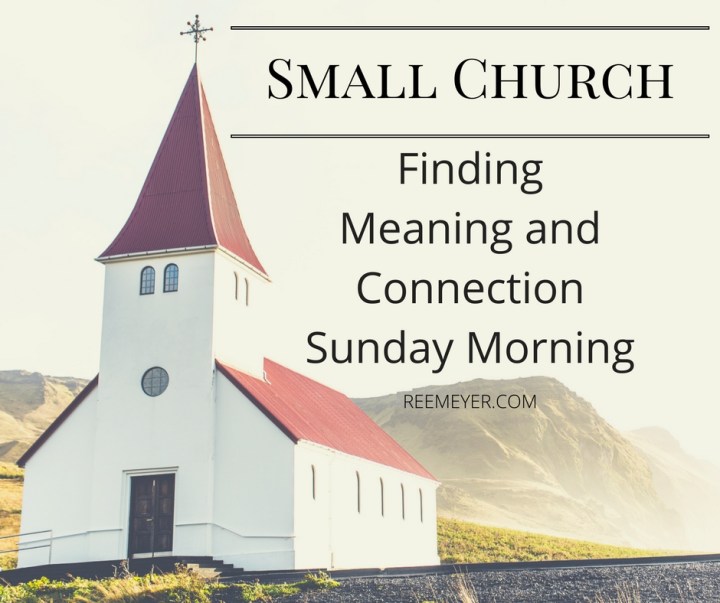
Small Church {Finding Meaning & Connection on Sundays}

I go to a big church.

And I love it. I love what a large church provides for me: Great teaching. Large and well organized children’s programs, vibrant worship with great production values, a wide variety of people making it easy to find kindred spirits and friends in my life stage.

Church is more than a building or a service, church is people. Community. Connection. And church should be a place where we learn to love those who are different from us, and find connection across life stage and natural affinity. That can be a lot harder to provide than good teaching, organized programs and exciting worship.

My church works hard to create welcoming community and connection (and I’m part of that work and welcoming), but in a bigger church, it is easy to go wide rather than deep.

I have the great privilege to be part of a team that puts on a college worship service a few blocks from our university campus. My involvement in college ministry and this service allows me to have the best of both worlds: I am part of a larger church with amazing resources and strong teaching. And my Sunday experience is close and connected, one I’ve had a voice in creating. I get to go to a big church and also have a small church experience.

College students are headed into finals next week, so this Sunday will be our last College Worship Hour until September. I am very much looking forward to a different schedule, and more family time while the kids are out of school and I work fewer hours. And during the summer, Sundays are truly “weekend”, as opposed to work days.

But I am going to greatly miss our little college worship service.

I will miss having a Sunday experience where I know nearly everyone’s name, can spot newcomers on sight and welcome them, where I can hug and be hugged.

I will miss having a more participatory, discussion oriented teaching time. A smaller group (we have between 100-150 each Sunday) allows us the freedom to include discussion times with those around, as well as large group. Most of us learn less by hearing and more by participating. I am grateful for a small space where there is more than one expert voice teaching about God, where we can learn from the Body of Christ, where a variety of voices discuss truth (with a pastor/teacher to guide us and keep us on track, of course. The discussion happens in the context of a traditional sermon.)

But most of all, I will miss communion. I don’t know at what point protestant churches dropped the Lord’s Supper as a weekly and regular part of their worship. But I wish we could pick it back up again. I wish we could pick it up as a weekly practice, and I wish we could make it communal and connected. Every Evangelical Church I’ve gone to practices communion every 6 weeks or so, and it is very individual. Small cups of juice, tiny cracker, passed around. You take your small portion of Jesus and you serve yourself.

Though it would be next to impossible in a big church, I LOVE the way we practice the Eucharist at College Worship Hour.

It is the centerpiece of our time together, and it is an invitation to come and receive Jesus. We use real bread. We have communion stations and servers. There is an extended time of silence or quiet music to think and pray, and when I am ready, I go to one of several places in the room. I step forward and cup my hands, telling the servers my name. And rather than taking, I receive. Someone (someone I know by name as well) hands me a chunk of bread and says, “Renee, the body of Christ was broken for you.” And then I dip my bread in the cup of juice and hear, “Renee, the blood of Christ was shed for you.”

Every Sunday I receive Christ.

And it is always meaningful, my eyes often pricking with tears. It is meaningful, and it helps me feel connected with Jesus. Some weeks I sit and pray and think for a while before moving toward the nearest communion servers. And some weeks I practically run to receive Jesus as soon as possible.

Maybe anything we do regularly, week after week, looses meaning and becomes routine. Maybe if enough years go by, I won’t feel such a deep hunger to receive Christ in the bread and cup. Maybe I won’t feel a weekly need to “remember Him.” (Luke 22:19)

But I don’t think so.

And though I love you, still we’re strangers
Prisoners in these lonely hearts
And though our blindness separates us
Still His light shines in the dark
And His outstretched arms are still strong enough to reach
Behind these prison bars to set us free
So may peace rain down from Heaven
Like little pieces of the sky
Little keepers of the promise
Falling on these souls the drought has dried
In His Blood and in His Body
In this Bread and in this Wine
Peace to you
Peace of Christ to you

“Peace”, Rich Mullins

What helps you find meaning and connection at church?

SmallChurch (1)

What does it mean to be a Christian? {Easter Thoughts}

Am I a Christian because I go to church on Sunday (and many of the other days)? Am I a Christian because of what I think about Jesus? Because I celebrate Christmas and Easter? Because I was raised to be a Christian? (I wasn’t, actually.)

I am a Christian because I believe Jesus is the Son of God, He is MY God. I have answered the great call to Follow Jesus. But as we slide down the last days of Lent into Easter weekend, I thinking about how easy it is for Christians to live as functional non-believers – myself included. We say we follow Jesus, but our lives bear no mark of Him. What better time than Easter weekend to contemplate what it really means to be a Christian, to follow Jesus.

Now before the Feast of the Passover, Jesus knowing that His hour had come that He would depart out of this world to the Father, having loved His own who were in the world, He loved them to the end. During supper, the devil having already put into the heart of Judas Iscariot, the son of Simon, to betray Him, Jesus, knowing that the Father had given all things into His hands, and that He had come forth from God and was going back to God, got up from supper, and laid aside His garments; and taking a towel, He girded Himself.

Then He poured water into the basin, and began to wash the disciples’ feet and to wipe them with the towel with which He was girded…

So when He had washed their feet, and taken His garments and reclined at the table again, He said to them, “Do you know what I have done to you? You call Me Teacher and Lord; and you are right, for so I am. If I then, the Lord and the Teacher, washed your feet, you also ought to wash one another’s feet. For I gave you an example that you also should do as I did to you.

Truly, truly, I say to you, a slave is not greater than his master, nor is one who is sent greater than the one who sent him. If you know these things, you are blessed if you do them. (John 13:1-17)

Jesus loved by lowering. John sees the love of Christ in the kneeling, serving Jesus. Jesus stripped, laying aside the garments of leader and teacher and taking the costume of a servant. Jesus washed even the feet of His betrayer, demonstrating love and service even for the hands that would slay Him. Read more