When You Don’t Have What it Takes {A Devotional on the Feeding of the 5,000}

I’ve been afraid of not having what it takes as long as I can remember.

As a child I was desperately afraid of failure, of trying out for something and not making it, of being told “you’re not good enough.”

In a world where girls tell everyone who their crush is, hoping it will get back to him, I never told anyone who I liked. Because the idea of anyone knowing I liked someone who didn’t like me back felt like the end of the world to me.

In college I finally got brave enough to apply for things I wanted to do, but I never told anyone (so if I didn’t get it, no one would know I wanted it.)

In my twenties I missed (or nearly missed) job opportunities because I waited to be asked. I assumed that my desire to be included was understood by everyone, desperately afraid to communicate what I wanted for fear of not being chosen, being told I wasn’t good enough.

Even to this day I wonder if there are dreams, opportunities, hopes I won’t even admit to myself because of this fear of being told no, or WORSE, trying and failing, finding out once and for all that I don’t have what it takes.

It’s so much easier to stick with sure things, never admit what I want or need, never take on more than I can handle.

Do you relate?

I am helping lead a Bible study this Fall for a precious community of women who are studying the table scenes in the book of Luke, looking at the way Jesus treated and interacted with people. Our study is called “The Radical Hospitality of Jesus”, and I’m learning more every week how much more radical Jesus was than I ever realized.


Learning about the radical hospitality of Jesus is stretching my boundaries, stretching my understanding of God, pushing against my ideas about who is in and who is out. The radical hospitality of Jesus is making me uncomfortable.

Sometimes as Christians we can fool ourselves into thinking following Jesus is all rainbows and unicorns, that it will happen naturally, when we do what is most comfortable to us.

But when we look at the life of Christ in Scripture, we see a path we may not even want to follow, and that I certainly don’t feel equipped to follow.

 RADICAL Hospitality.

I see Jesus welcoming outsiders and social outcasts and I am overwhelmed. I can’t even manage to make time for my neighbors.

Jesus crossed political and economic and social boundaries and I can’t even handle following my crazy relatives on Facebook.

I do not actually have what it takes to practice the radical hospitality of Jesus.

Which is not a surprise to God AT ALL. He knows that sometimes the Radical Hospitality of Jesus will require more than we have to give.

Our passage this week is like a breath of fresh air.

Jesus took them away, off by themselves, near the town called Bethsaida. But the crowds got wind of it and followed. Jesus graciously welcomed them and talked to them about the kingdom of God. Those who needed healing, he healed.

As the day declined, the Twelve said, “Dismiss the crowd so they can go to the farms or villages around here and get a room for the night and a bite to eat. We’re out in the middle of nowhere.”

“You feed them,” Jesus said.

They said, “We couldn’t scrape up more than five loaves of bread and a couple of fish—unless, of course, you want us to go to town ourselves and buy food for everybody.” (There were more than five thousand people in the crowd.)

But he went ahead and directed his disciples, “Sit them down in groups of about fifty.” They did what he said, and soon had everyone seated. He took the five loaves and two fish, lifted his face to heaven in prayer, blessed, broke, and gave the bread and fish to the disciples to hand out to the crowd. After the people had all eaten their fill, twelve baskets of leftovers were gathered up. (Luke 9:11-17)

Of the 8 table scenes we’re discussing in our study, this is the only one where Jesus is actually the host. He’s welcoming the crowd, and ultimately He provides for them. But He invited the disciples to participate with Him in welcoming and providing.

Jesus is inviting them into the life of dependence that offers God our human not-enough, offers what we have to God with thanks and prayer, and sees Him bless, break and give.

I believe this miracle, this sign can be a way of life for us as well. A life of dependence on the Father that offers our not-enough and sees Him make it more than enough.

I don’t think God is calling us to live limitless, boundary-less lives. We have to say no, and we have to recognize our humanity. He is God, we are NOT. If I am the answer, then He’s not, and that is a problem.

On the other hand, I tend to look at what God is calling me to through the lens of my own resources.

Forget about big miraculous callings, just simple life and motherhood and being a wife and friend and person in this hurting world is more than my resources can take.

I don’t have the wisdom, I don’t have the energy, I don’t have the patience, I don’t have what it takes to be who God has called me to be in the world. I don’t have what it takes to practice the radical hospitality of Jesus.


Which is not a surprise to God AT ALL. He knows that sometimes the Radical Hospitality of Jesus will require more than we have to give.

BUT.

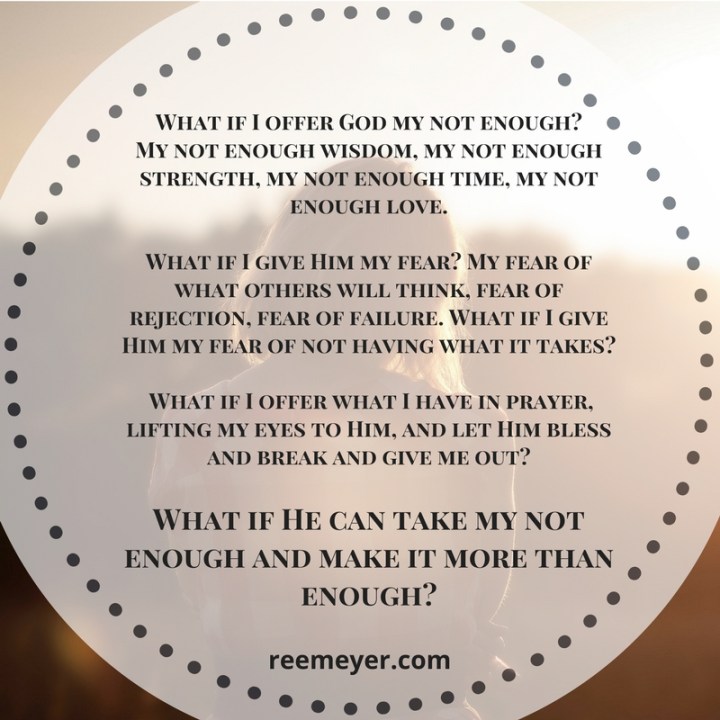
What if I do what the disciples do in this story: What if I offer God my not enough?

My not enough wisdom, my not enough strength, my not enough time, my not enough love?

What if I give Him my fear – fear of what others will think, fear of rejection, fear of failure? What if I give Him my fear of not having what it takes?

What if I offer Jesus just what I have, my own self. What if I offer what I have in prayer, lifting my eyes to Him, and let Him bless and break and give me out.

What if He can take my not enough and make it more than enough?
 

When You Don't Have What It Takes Insta Quote

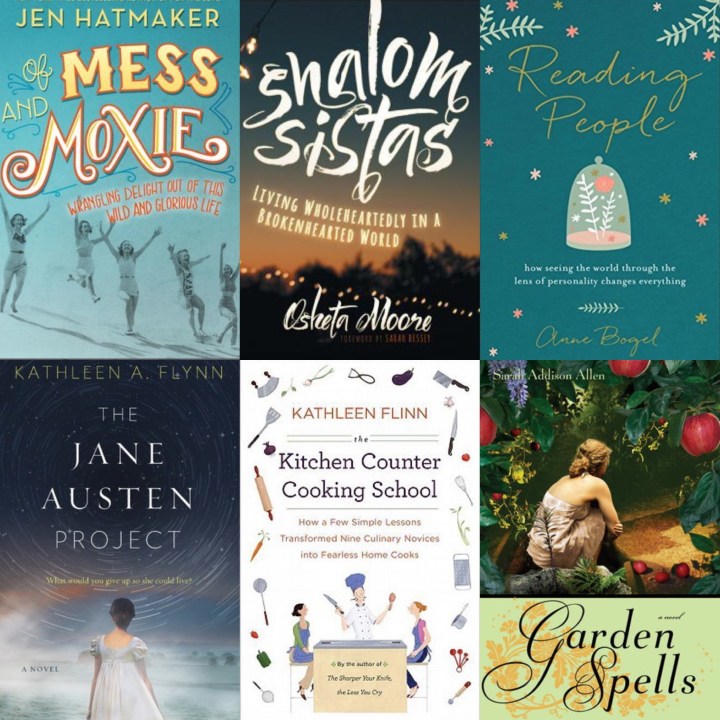
What I’m Reading Right Now: September Book Review

IMG_1035

Things stay pretty full around here until our college retreat in mid-October, so I’m excited to see that I was able to get 6 books read in September. But because I know some of you think audiobooks don’t count as reading (they totally count.), full disclosure: I listened to 3 of these.

I can’t really pick a favorite non-fiction this month, I LOVED all three, for totally different reasons. I think you should read them all.

Fiction is easier, Garden Spells was a DELIGHT. Like last month, I set aside part of my Saturdays specifically for rest and reading, trying to care for my soul in the midst of this busy time of year. Garden Spells was my book date on one of those Saturdays and I read it in that one day, practically in one sitting.

Read on for more specifics!

Read more

Building Bridges Instead of Walls (Or, How I travel the world every Thursday without leaving town.)

I love to travel.

My whole life I dreamed of traveling. We didn’t have much money, and my single mama saved for years to make Disney World happen for us when I was 13. I was SO EXCITED to be going during Epcot Center’s inaugural year. The World Showcase was my favorite, even though only a few countries were finished back then. I walked through the Disney versions of far away places and dreamed that some day I’d see the real thing.

Headed into college I was sure I’d spend a year or more in the Peace Corps when I finished, but life takes unexpected turns. I was 27 before I went anywhere further than Mexico. My first transatlantic trip was to the London & Paris, and the UK will always have a special place in my heart, having visited friends studying at Cambridge several times over the years.  For 3 years early January meant a work trip to the (beautiful) southern coast of Spain, and I celebrated a delightful Christmas in China. I spent 2 memorable summers teaching English in Uzbekistan, another place where I left part of my heart.

My favorite thing about my pre-marriage and motherhood life was the opportunities it provided to travel, learn other cultures, meet people who are different from me.

Then I got married and became a mom. And moved to Lincoln, NE, which feels like the whitest white bread place on earth sometimes. I felt trapped in the very heartland of the United States, unable to travel, unable to find any outlet for the part of me that feels made to share life with people of other cultures.

There are certainly international students at the University here, and I’ve learned that my white bread city is a major welcome center for refugees (Go Nebraska!) But in those young mom years I never could figure out how to make either of those groups part of my weekly life. I always wanted to, but I never acted on it.

And then, 3 years ago, I found myself sitting with my then-15 year old at the DMV, jumping through the hoops we needed for his driving permit. As he took the written test, I sat in a room with all the waiting people. Is there a place that makes you feel more like a number/less like a person than the DMV? My seat faced directly into the doorway through which the wait-ers were called to jump through whatever hoops they needed to jump. I watched people move from testing location to camera to whomever else they needed to see in order to get what they need.

My eye was caught by a precious older lady, who looked Chinese, and definitely did not have English as her first language. She did not understand what the DMV worker wanted her to do. I’m sure that the DMV is a hard place to work, and maybe this DMV lady was having a rotten day. But her response to the lack of understanding was to repeat herself, several times, growing ever louder, and with an ever more distinct tone of “are you stupid?”

As I sat glued to my chair, memories of my time in China flashed back to me: The welcome I received. The kind politeness of everyone I met, listening as I practiced my 3 super-basic Mandarin phrases. The excitement of every English learner I met, so happy to have a native speaker to talk to.

Something rose up in me. I didn’t have this language for it at the time, but now I recognize it as the desire to build bridges rather than walls.

The desire I felt in that moment to help, to DO SOMETHING, was met 3 days later when my church hosted a community involvement weekend, where they invite various non-profits (faith based and otherwise) to have booths and share information. I walked out of the sanctuary and straight over the the Lincoln Literacy table.

Within a couple of months I had completed training and walked into a room of English Language Learners, well on my way to Thursdays being my favorite day of the week.

I wish I’d kept a running list of the countries represented in my classes. For sure I’ve spent time with people from Myanmar, China, Sudan, Eritrea, India, Ukraine, India, Japan, Korea, Bolivia, El Salvador, Tanzania, Egypt, Afghanistan, and many many friends from Iraq and Kurdistan.

For the first two years I tutored the highest level class, helping them practice reading, writing and speaking. My student friends were refugees, immigrants, wives of men working at the Kowasaki Office here, wives of Graduate Students, Graduate Students themselves. Many of them were far more educated than I am.

In the level 4 class the greatest skill I brought was my ability to talk. We discussed our lives and backgrounds, the weather and the world, we read books, we practiced grammar and we talked politics.

I’ll never forget teaching refugees and immigrants during the divisive 2016 election season, where such terrible things were said about non-Americans, with the focus on borders and walls.

I watched as people from thousands of miles apart, separated by geographical, religious, and gender barriers worked together to understand what their crazy American teacher wanted them to do. I watched them build bridges rather than walls.

I had a front row seat to hard work, determination, and the amount of hard work and determination it takes for someone from the other side of the world to end up here in Lincoln, Nebraska (the narrative that our borders are wide open and it is easy to get into the US is a lie.)

I cried with student friends who had been working hard and hoping endangered family members in their ISIS torn home country would be able to join them here in safety, as their hopes were dashed by ban on travel to the US from Muslim countries.

This year I’m working with beginners, the lowest level. I’m awed by the courage it takes to start life over in a place where you have to have carry a piece of paper with your name and pertinent information because you can’t communicate that yourself. I’m amazed at the sheer audacity of someone who is illiterate in her first language, trying to learn English. I’m in love with the smiles that light up my friends’ faces when they understand.

And from my home right here in the heartland, I am BLESSED. I am made rich. I’m inspired. I’m braver, I want to work harder. This is what I’ve learned from people who look and sound different from me. Though in many ways I’m their teacher, I’m the one who is learning. Though in many ways I’m their host, I’m the one who has been welcomed.

If you’ve been feeling the nudge to build bridges rather than walls, may I gently suggest that you respond, that you step into that, whatever it looks like for you, today? I wish I had done this sooner.

Maybe you’ve felt called to feed the poor. Serve with the homeless. Encourage prisoners. Welcome Refugees. Google what’s available in your area, and jump in. It might be scary, but I bet it will also be good.

If you’re local and interested in  helping English Language Learners, I could not recommend the work that Lincoln Literacy is doing more highly. They will train you, and the commitment is 1-2 hours a week (more if you want.) I tutor a class (8-10) because that was my preference, but they have 1 on 1 tutoring as well. It helps that I have an English Grammar background, and had some idea how to plan lessons. But if you can talk, you can do this. I volunteer in the refugee program, but they also work with folks from the wider international population as well as adults with disabilities who need literacy help. My fellow Lincoln Literacy tutors come from every background you can think of: Stay at home moms, retired folks from many fields, professors, armchair travel dreamers like me.

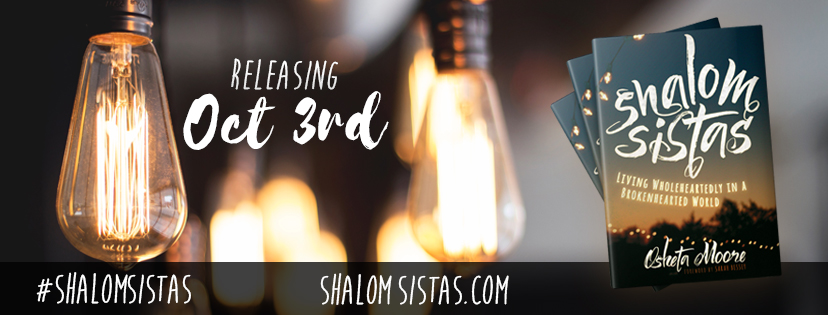
And if you’re interested in learning more about how we can build bridges instead of walls, there’s a whole chapter on this, including LOTS of practical suggestions, in my friend Osheta’s book, which I talked about last week!


Building Bridges Instead of Walls Insta Quote (1)

Photo used in my images is by Ben White on Unsplash

I Will Be Satisfied.

In India this summer, I loved getting to meet people from various religions and learn what they believe and how that faith affects their lives. But I also loved and was greatly impacted by watching and learning from my Indian brothers and sisters, believers in Jesus.

One Sunday evening we had the opportunity to visit a small home-church gathering. This handful of  Indian Christians meet in an apartment in a part of town where very few Christians live, to sing, and pray and study the Bible together each week. It was beautiful.

A young man with a guitar led our singing, interrupting the songs periodically to pray. He thanked the Lord for His presence. For their American guests. For the gift of meeting together. For God’s Word and wisdom and guidance. For His goodness.

As he prayed and sang, this young man would periodically pause and say, Read more

I am a Shalom Sista

I’ve been thinking about the concept of peace for a long time.

In my family, peace was the absence of conflict, something you kept by not arguing, not rocking the boat.

In the Christian environment I was born into in college, peace was this magical quality that helped you make decisions. “I had a peace about it.”

Lovely, except that “not rocking the boat” can lead to enabling unhealthiness, and create more relational strain than an honest approach.

And for me, decision making is inherently un-peaceful. I literally have NEVER “had a peace” about a decision before it is made, because I fear making wrong decisions.

Thankfully, at some point in my twenties, I heard one of my favorite Bible teachers explain peace as the product of trust in God and submission to the Prince of Peace. “AHA!” I thought, “Finally, a peace that seems healthy and attainable for me.” And I still think true peace in my spirit comes first and foremost when I am trusting God and surrendered to His goodness, regardless of my circumstances.

But that definition of peace is limited to my own experience – I can trust and surrender to God’s goodness myself, but I can’t force it on others.  And as I continued to study my Bible, particularly the Psalms and New Testament Kingdom theology, I increasingly felt the need for a broader definition. A peace we can live out of, but also into.

I found it when I learned the concept of Shalom. The word translated peace in our English Old Testaments means wellness, completeness, safety, flourishing. 

This is what God is doing in our hearts and in the world, bringing Shalom. And this is what God is inviting us to join Him in: experiencing His shalom and carrying shalom into the world.

Read more

You are Invited.

As a young believer learning to share her God story, I was taught to describe the process of entering relationship with God as “inviting Jesus into my life.”

As a more mature believer teaching Sunday School and VBS, I’ve used the words, “Ask Jesus into your heart.”

Over these years of wanting more of God, asking Him to break out of what I think of Him and show me where my God view doesn’t match up with who He is in the Bible and reality, I’ve moved away from talking about relationship with God in this way.

I’m not sure I have a great suggestion for replacement words, but I have enough of an issue with the concept of inviting Jesus into my life/heart that I won’t use this wording with my own kids.

Because “I invited Jesus into my life” makes it sound like I initiated the relationship. It can fool me into thinking I made the first move. And however you want to describe the beginning of your relationship with Jesus, God went first.

We see this throughout the pages of Scripture: In the beginning, God… (Genesis 1:1)

This is the story for countless Old Testament Hebrews, some God-seekers like Abraham and Job, others running from God like Jonah and Jacob. Their stories begin  “Now the Lord said to Abram…” And “The Word of the Lord came to Jonah…”

It is no different in the Gospel accounts of Jesus’ life, where fishermen and tax collectors are minding their own business, doing their day jobs, and Jesus walks up and says, “Follow Me.”

I’m studying the story of Levi/Matthew’s calling this week, and I’ve been captivated by the first line:

After that He went out and noticed a tax collector named Levi sitting in the tax booth, and He said to him, “Follow Me.” Luke 5:27

He noticed a tax collector named Levi…

I spent years of my single life hoping to be noticed, longing to be chosen. I spend many of my hidden days, those family days no one sees, still longing to be noticed, wondering if what I do matters.

What does it mean to you that Jesus notices?

He noticed a tax collector named Levi…and He said to Him, ‘Follow Me.'”

The Message paraphrases “follow Me” as “Come along with Me.” Jesus’ notice is not limited to the Spiritual Elite. His attention is not reserved for those who’ve proven themselves, earned His favor.

Jesus’ invitation to live life with Him is given here to the tax collector. The rejected, the despised, the not-good-enough. The outsider.

What does it mean to you that Jesus’ notice of you is not something to be afraid of? That He’s not going to notice you and then find you not good enough?

Levi responds to Jesus’ invitation with a big YES: He walks away from his dishonest livelihood, his identity and his shame, and goes where Jesus goes.

And then Levi throws a big party for Jesus, and invites all his tax collector friends.

This is what we church people want from new believers, right? This is the perfect success story, something we could show  and celebrate on a Sunday morning video, a sinner who walks away from his sin, and introduces Jesus to all of His friends.

For all our strategies and programs, this process is usually a lot longer. It can take new believers years to turn away from their livelihood, identity and shame. And it can take even longer years before people learn (usually through some sort of “training”) how to share Jesus with their friends.

Maybe times have just changed. Maybe that’s just life, and it takes longer sometimes, and that is fine.

Or maybe it takes longer because we see ourselves as the ones inviting Jesus.

We don’t see Him noticing us. Choosing us. Welcoming us even as He knows our sin and shame. Inviting us into life with Him not in spite of these things, but because of His great love.

What does it mean to you that Jesus invites you, just as He invited Levi?

Does it change how you think of God to realize that He initiated relationship with you, that He always goes first?

He chose us in Him before the foundation of the world… Ephesians 1:4

You Are Invited IG


Talking to kids about their bodies and S-E-X: RESOURCES

As a follow up to my post Thursday about talking to our kids about sex and their bodies, today I’m sharing a podcast and 2 great books that have been super helpful in teaching our kids about sex and their bodies.

Resources for Talking to Kids about Sex

Read more

Talking to kids about their bodies and S-E-X

Parenting is a learn-on-the-job adventure, never more so than in figuring out how to talk to your kids about their bodies and sex.

Like nearly every girl of my generation, I was handed a book about sex (probably something terrifying like “Growing Up Is Beautiful”) and taught myself how to use tampons by reading the Kotex box. My sweet Mama did better than her own parents, she had no idea what was happening when she started her period and thought she was dying.

So here I am trying to raise healthy kids – boys! – wanting to do a good job teaching my kids about their bodies and sexuality, wanting openness and to avoid shame. Wanting them to be ready for this age of sexualized rice-a-roni commercials and p0rnography that is available 24-7 at the click of a button.

If we ever get to know if we’ve succeeded in this area, it won’t be until they are older, but we’re trying hard to be proactive in this area. We’ve made a few decisions and found a few resources that have been super helpful. Read more

On Knowing When to Speak and When to Be Silent

I have a voice.

Sometimes it can be loud, and I hate being shushed. My voice is one of the things that makes me feel like I am too much for people. Being loud makes me feel like I’m not feminine or soft or “Christian womanly” enough.

I have a voice.

Because of my life, job, different opportunities and even my (sometimes too loud for people) personality, people listen to me.

I have a voice, and I am not afraid to use it.

I want to speak up for the oppressed. I want to draw out the silenced. I want to encourage the discouraged, speak truth into lies, speak life and value over myself, my family, those close to me, and anyone who crosses my path.

I have a voice.

But sometimes I feel silenced. It can feel like a woman has to speak louder than is socially acceptable in order to be heard, and I don’t want to be “that woman.” It feels like my little words have no impact on the lies and fighting and noise in the world. Even in prayer, it can feel like what I want, what I’m asking God to do in my life and in this hurting and broken world, are just words thrown to the wind.

Faith is a necessary element to Christianity. But faith in what? I want to grow in faith that God hears me.

And as I grow in certainty that He hears me, I want to grow in claiming Him as my first audience. I want to go first  to Him with my fears, concerns, joys, and worries. Before I let something rattle around in my head for days and weeks, before I pour out complaints and fears to a friend, before I share a praise or celebration online, I want God to hear my voice.

Give ear to my words, O LordConsider my groaning.
Heed the sound of my cry for help, my King and my God, For to You I pray.
In the morning, O Lord, You will hear my voice;
In the morning I will order my prayer to You and eagerly watch.

Psalm 5: 1-3 (NASB)

In a world that is loud, how do we practice silence? How do we avoid contributing to the noise and strife and outrage-fueled peaceless-ness?

In a world that silences us, how do we learn to speak up? To claim our right to consent, own our own preferences, opinions, feelings? How do we claim our right to speak in a world that doesn’t want to hear our voice?

Perhaps this is a purpose for prayer, a reason why we pray.

Not to get what we want, not for answers, but to teach us.

Perhaps prayer is a place where we can practice believing we are heard.

Perhaps if I submit my voice to God first, I will gain confidence in being heard, valued, loved by my heavenly Father.

And perhaps then I will learn when to speak, and when to be silent.

I love the Lord, because He hears My voice and my supplications.
Because He has inclined His ear to me, Therefore I shall call upon Him as long as I live.

Psalm 116:1-2 (NASB)

When to Speak, When to be Silent quote (1)

Photo in my images is by Jason Rosewell on Unsplash

What I wish I’d known about being a Stay-at-Home-Mom

This September I begin my third year sending my kids off to school as I head to work. It was both scary and liberating to enter the work force again, to receive a paycheck (be it ever so small), to feel officially and legally employed after years of working hard for free.

I don’t really miss being home with young kids all day, but I do miss that season of life. And like so many seasons, I feel like I was just really learning how to survive Stay-At-Home-Mom-hood as I left it behind.

Here are 4 things I wished I’d known about being a Stay-at-Home-Mom (or at least learned more quickly, and remembered more readily): Read more