Now seems like a great time to revisit “DO NOT FEAR.”

So much in our lives tempts us to look at obstacles, at our lack, at the things we fear. And God invites us to look to Him, to look to love. How do you fight fear with the knowledge of God's love?

Considering that March 2020 was 2 years long, it’s not surprising that Spring 2018 seems like a million years ago. At the time, I was in the middle of a long, hard season, facing a lot of unknowns.  I survived that season in part by taking a long, hard look at the Bible’s most repeated command: Do Not Fear.

I took everything I learned from that study and turned it into a devotional. I thought now might be a great time to offer that again, as now we’re all in a place with lots of unknowns.

It’s free on the  FREE BIBLE STUDIES AND RESOURCES TAB on the upper right corner of my website. Or just click here.

Here’s what I said about it at the time…

So much in our lives tempts us to look at obstacles, at our lack, at the things we fear. And God invites us to look to Him, to look to love.
How do you fight fear with the knowledge of God’s love?
What would it take to for us to be so sure of God’s love of us that His love would drown out our fears?

It’s a PDF, so you can download it and print it, or just read it on your phone or tablet.

Enjoy, and pass it on to anyone you think will be helped! Things might get pretty scary around here, but we don’t have to be afraid.

Surprised by Jesus

I spent the last 5 days with 124 amazing students, in the beautiful Rocky Mountains, talking about meeting God in ordinary and surprising ways. I got to lead a meditation on one of my favorite Bible stories…about a woman who went looking for Jesus but was still surprised by Him.

But as He went, the crowds were pressing against Him. And a woman who had a hemorrhage for twelve years, and could not be healed by anyone, came up behind Him and touched the fringe of His cloak, and immediately her hemorrhage stopped. (Luke 8:43-44)

In her culture, this woman would have been unclean, untouchable. I imagine she was lonely, and I am sure she dealt with shame.  In Mark’s account of this interaction, he adds the detail: “she had endured much at the hands of many physicians, and had spent all that she had and was not helped at all, but rather had grown worse…”

Lonely, ashamed, exhausted. Helpless and hopeless, she goes looking for Jesus.

And a woman who had a hemorrhage for twelve years, and could not be healed by anyone, came up behind Him and touched the fringe of His cloak, and immediately her hemorrhage stopped.

Matthew’s account tells us she thought to herself, “If I only touch his garment, I will be healed.” Helpless and hopeless, she goes looking for Jesus, hoping, expecting to be healed.

By Jewish law her uncleanness made her untouchable, but still she entered this pressing crowd (I picture it like leaving a Husker game where you’re pressed together like slowing moving sardines. By pressing in with the crowd, she made them all ceremonially unclean, something they surely would have resented.

This was a brave act, but she was desperate.

Where is the surprise in our story? She went into the crowd expecting that if she could just get near enough to Jesus she would be healed and she was. No surprise. Yet.

And Jesus said, “Who is the one who touched Me?” And while they were all denying it, Peter said, “Master, the people are crowding and pressing in on You.” (Luke 8:45)

Peter basically says, “Dude, everyone is touching you!”

But Jesus said, “Someone did touch Me, for I was aware that power had gone out of Me.”

When the woman saw that she had not escaped notice, she came trembling and fell down before Him, and declared in the presence of all the people the reason why she had touched Him, and how she had been immediately healed. (Luke 8:46-47)

This bleeding woman expected to touch Jesus and be healed.

But she WASN’T expecting to be noticed by Him.

She wasn’t expecting a personal encounter.

This woman wanted what Jesus had for her. But she wasn’t expecting Jesus to see her. She wasn’t expecting to be noticed.

She wasn’t expecting to have to tell her story. And she tells it publicly, in front all those people she made unclean. What is it about Jesus that made her brave enough to do that?

I don’t know for sure, but I do know what He said to her:

And He said to her, “Daughter, your faith has made you well; go in peace.” (Luke 8:48)


Can you put yourself in this woman’s place? Picture yourself, wading into a crowd of people around Jesus.

This woman had a hemorrhage, a 12 year health problem that had exhausted all of her resources. A great shame. Think of your own greatest shame. Your greatest need for healing. What do you want from Jesus?

Are you brave enough to push into the crowd around Jesus? Do you believe that He has what you need?

What do you need from Jesus? Picture yourself reaching out to touch Him, asking, needing, wanting.

Are you surprised that He sees you?

And friend, He DOES see you. You have not escaped His notice.

Picture Him, seeing you. Searching all the crowd for yours.

Are you afraid?

The woman was afraid, she came forward, trembling. I think she was terrified. She came trembling and fell down before Him.

Picture the expression on Jesus’ face as He looked down on her. What do you think she found in His eyes? Judgement? Condemnation? Disgust?

Or mercy? Kindness? Love.

To the woman’s great surprise, He called her daughter. DAUGHTER.

Picture yourself, trembling and terrified, bringing your shame, your hurt, your need before Jesus.

What do you see in His eyes, as He sees you? What does He say to you?

Can you hear Him calling you daughter? Son?

Jesus sees you. He calls you son, He calls you daughter.

Are you surprised?

Surprised by Jesus: A Devotional Meditation on Luke 8:43-48


Photo in my images by John Price on Unsplash

When You Don’t Have What it Takes {A Devotional on the Feeding of the 5,000}

I’ve been afraid of not having what it takes as long as I can remember.

As a child I was desperately afraid of failure, of trying out for something and not making it, of being told “you’re not good enough.”

In a world where girls tell everyone who their crush is, hoping it will get back to him, I never told anyone who I liked. Because the idea of anyone knowing I liked someone who didn’t like me back felt like the end of the world to me.

In college I finally got brave enough to apply for things I wanted to do, but I never told anyone (so if I didn’t get it, no one would know I wanted it.)

In my twenties I missed (or nearly missed) job opportunities because I waited to be asked. I assumed that my desire to be included was understood by everyone, desperately afraid to communicate what I wanted for fear of not being chosen, being told I wasn’t good enough.

Even to this day I wonder if there are dreams, opportunities, hopes I won’t even admit to myself because of this fear of being told no, or WORSE, trying and failing, finding out once and for all that I don’t have what it takes.

It’s so much easier to stick with sure things, never admit what I want or need, never take on more than I can handle.

Do you relate?

I am helping lead a Bible study this Fall for a precious community of women who are studying the table scenes in the book of Luke, looking at the way Jesus treated and interacted with people. Our study is called “The Radical Hospitality of Jesus”, and I’m learning more every week how much more radical Jesus was than I ever realized.


Learning about the radical hospitality of Jesus is stretching my boundaries, stretching my understanding of God, pushing against my ideas about who is in and who is out. The radical hospitality of Jesus is making me uncomfortable.

Sometimes as Christians we can fool ourselves into thinking following Jesus is all rainbows and unicorns, that it will happen naturally, when we do what is most comfortable to us.

But when we look at the life of Christ in Scripture, we see a path we may not even want to follow, and that I certainly don’t feel equipped to follow.

 RADICAL Hospitality.

I see Jesus welcoming outsiders and social outcasts and I am overwhelmed. I can’t even manage to make time for my neighbors.

Jesus crossed political and economic and social boundaries and I can’t even handle following my crazy relatives on Facebook.

I do not actually have what it takes to practice the radical hospitality of Jesus.

Which is not a surprise to God AT ALL. He knows that sometimes the Radical Hospitality of Jesus will require more than we have to give.

Our passage this week is like a breath of fresh air.

Jesus took them away, off by themselves, near the town called Bethsaida. But the crowds got wind of it and followed. Jesus graciously welcomed them and talked to them about the kingdom of God. Those who needed healing, he healed.

As the day declined, the Twelve said, “Dismiss the crowd so they can go to the farms or villages around here and get a room for the night and a bite to eat. We’re out in the middle of nowhere.”

“You feed them,” Jesus said.

They said, “We couldn’t scrape up more than five loaves of bread and a couple of fish—unless, of course, you want us to go to town ourselves and buy food for everybody.” (There were more than five thousand people in the crowd.)

But he went ahead and directed his disciples, “Sit them down in groups of about fifty.” They did what he said, and soon had everyone seated. He took the five loaves and two fish, lifted his face to heaven in prayer, blessed, broke, and gave the bread and fish to the disciples to hand out to the crowd. After the people had all eaten their fill, twelve baskets of leftovers were gathered up. (Luke 9:11-17)

Of the 8 table scenes we’re discussing in our study, this is the only one where Jesus is actually the host. He’s welcoming the crowd, and ultimately He provides for them. But He invited the disciples to participate with Him in welcoming and providing.

Jesus is inviting them into the life of dependence that offers God our human not-enough, offers what we have to God with thanks and prayer, and sees Him bless, break and give.

I believe this miracle, this sign can be a way of life for us as well. A life of dependence on the Father that offers our not-enough and sees Him make it more than enough.

I don’t think God is calling us to live limitless, boundary-less lives. We have to say no, and we have to recognize our humanity. He is God, we are NOT. If I am the answer, then He’s not, and that is a problem.

On the other hand, I tend to look at what God is calling me to through the lens of my own resources.

Forget about big miraculous callings, just simple life and motherhood and being a wife and friend and person in this hurting world is more than my resources can take.

I don’t have the wisdom, I don’t have the energy, I don’t have the patience, I don’t have what it takes to be who God has called me to be in the world. I don’t have what it takes to practice the radical hospitality of Jesus.


Which is not a surprise to God AT ALL. He knows that sometimes the Radical Hospitality of Jesus will require more than we have to give.

BUT.

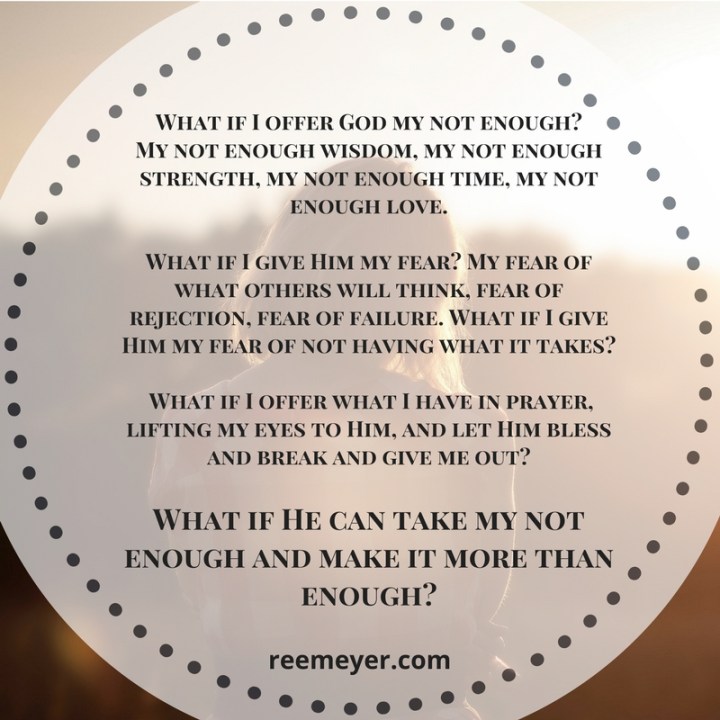
What if I do what the disciples do in this story: What if I offer God my not enough?

My not enough wisdom, my not enough strength, my not enough time, my not enough love?

What if I give Him my fear – fear of what others will think, fear of rejection, fear of failure? What if I give Him my fear of not having what it takes?

What if I offer Jesus just what I have, my own self. What if I offer what I have in prayer, lifting my eyes to Him, and let Him bless and break and give me out.

What if He can take my not enough and make it more than enough?
 

When You Don't Have What It Takes Insta Quote

The Call of Jesus: Come to Me and Learn REST

“Come to Me, (JESUS SAYS) all who are weary and heavy-laden, and I will give you rest. Take My yoke upon you and learn from Me, for I am gentle and humble in heart, and you will find rest for your souls. For My yoke is easy and My burden is light.” (Matthew 11)

I have always understood this invitation “come to Me and I will give you rest” by itself, as if Jesus is saying “Come to me, TAKE A NAP. I’ll do everything else.” And Jesus has done it ALL. All our spiritual needs are met in Him. The search is over. When we find Jesus, we’ve found God. And there’s nothing wrong with a good nap.

But a spiritual nap is not what Jesus is promising here. Because to find the promised REST, we have to “take His yoke upon us and learn from Him”. Read more

The Call of Jesus: Come to Me and Learn to be a Daughter or Son

“Come to Me, (JESUS SAYS) all who are weary and heavy-laden, and I will give you rest. Take My yoke upon you and learn from Me, for I am gentle and humble in heart, and you will find rest for your souls. For My yoke is easy and My burden is light.” (Matthew 11:28-30)

We step into Matthew’s story as Jesus is addressing the crowds. Earlier in Matthew 11, Jesus received messengers from His cousin John the Baptist, in prison and wondering if Jesus is indeed the Messiah (spoiler alert: He is).

Then Jesus denounces the cities where He performed miracles because they saw Him and did not recognize Him.

Those near Jesus, who saw Him perform miraculous healing did not all believe and respond to Him.

So Jesus breaks into prayer:

“I praise You, Father, Lord of heaven and earth, that You have hidden these things from the wise and intelligent and have revealed them to infants.  Yes, Father, for this way was well-pleasing in Your sight.  All things have been handed over to Me by My Father; and no one knows the Son except the Father; nor does anyone know the Father except the Son, and anyone to whom the Son wills to reveal Him.

The wise and intelligent (religious leaders) couldn’t receive the things of God in the package of Jesus. Here in Matthew, Jesus is saying, “If you can’t see who Father is in Me, then you can’t see the Father.”

When Jesus talks about knowing His Father, He’s not talking about book learning, a life of studying about the Father.

He learned what His Father was like the way every child understands her parents: not by studying books , but by living His life with Him. Jesus learned what His Father was like by listening for his voice, and learning from him.

A son learns to be like his father by living in His father’s house, by growing up with him.

So as the Son, the One who best knows the Father’s heart, Jesus makes this invitation:

“Come to Me, all who are weary and heavy laden, and I will give you rest.”

Jesus is inviting us to come and learn. And the first thing we learn from Jesus is SONSHIP. This is the yoke of Jesus, the yoke of Sonship, of a dearly beloved child.

If I’m not functioning as one dearly beloved of the Father, then I’m not functioning out of the yoke of Jesus.

If our view of the Father doesn’t match up with the love demonstrated by Jesus, who said, “If you’ve seen me, you’ve seen the Father”? Then we’re not functioning out of the yoke of Jesus.

I learned and am still learning to lay down the old yoke, my old ways of being OK in the world. And I am learning (slowly, day by day) to come to Jesus and let Him teach me the way of sonship, the way of the Beloved of the Father. I am learning to be a daughter. The way of the Beloved.

This is the way of rest. And it is good.

Come to Me and Learn to be a daughter quote (1)

Over the next few weeks, I’m sharing my own lessons and thoughts from a Bible study I wrote with my friend Stacey and did with a group of (amazing) women last Fall. This 8 week study, The Call of Jesus, is available for free here or by clicking the “Free Bible Studies and Resources” link in my blog header. If you’re looking for a Bible study to do yourself or with friends this Fall, check it out!

The Call of Jesus: Come to Me and LEARN a New Way

Growing up my value system was unknowingly ruled by 3 main things, 3 ways I managed life in order to know that I was OK.

Reputation. I was a hard worker, not for the sake of achievement or because I valued excellence really, but because I valued being thought well of. I was driven by reputation.

Relationship.  I felt good about myself because of who my friends were. And I was a good and caring friend – sometimes at the expense of my own needs, and in spite of my better judgment. I was a good and caring friend so that people would like me. Because I needed them to be my friend, I needed them to like me, I needed to be needed.

Responsibility. As the oldest child in a split and blended family, I felt responsible for everyone. I was aware that the younger ones were watching, that I was expected to be a good influence. I was always aware of my responsibility. I didn’t realize it at the time, but now I see: I thought I could overcome the hurt and pain and unpredictability in our family for myself, my siblings, even my parents, by the power of my own responsibility and reliability. W

This was my value system, my way of managing life and being OK: Reputation, Relationship and Responsibility (and I was much better at being responsible for others than I was for myself.) That is how I was OK in the world.

Then, halfway through college, I met Jesus. I fell head over heels in love with Him. He filled up empty spaces I didn’t even know I had.

For years, this is how I shared my story: Before Jesus, I found safety, security, LIFE in relationships & reputation. But then I met Jesus and learned to find safety, security, life in Him.

I had been a Christian and telling this story for over 10 years before I realized it was a lie. Read more

A Prayer for Peace {Psalm 122}

Last year our college ministry spent the summer in the Psalms, and our staff directional team took turns writing devotionals for each Psalm that we covered. While I am traveling and working on some long term projects this summer, I thought I’d share some of the devotionals I wrote. Today’s is on Psalm 122, which you can read here.

Imagine you are one of the children of Israel, in the generations after exile.

You were born of a people covenanted to Yahweh God, married to the Most High. Your ancestors followed Yahweh out of Egypt, through the wilderness and into the land of promise – Israel. You grew up listening to stories of the golden years – when Israel was united under King David and worship centered around the temple in Jerusalem. Jerusalem, named the city or fountain of shalom (peace, wholeness,  flourishing.) But along with those golden stories, you also grew up with stories of darkness, consequences, judgment. Your ancestors, your people, were unfaithful to Yahweh. They joined themselves to other gods, sought protection through military might and treaties with foreign nations rather than in Yahweh your God. And so – as was promised in the ancient texts, and warned of by prophet after prophet, the mighty men of old – your people were removed from the land. Carried off by the very foreign powers they had looked to for safety and security. Jerusalem, the city of peace, was lost. The temple in ruins, the people were removed from the land of promise. You inherited generational guilt and consequences of sin, through no fault of your own – you were born into exile.

Imagine you are one of the children of Israel born in exile. You were raised on these stories, but you were also raised on promise – the promise of Yahweh’s lovingkindness, the promise of the prophets – that after the judgment would come restoration and return, and some day, a Messiah. A Christ. A King to return Israel to what she should have been. A return of Shalom to Jerusalem, the city of Shalom. And now you are seeing kept promises begin to rise like dawn. Jerusalem is being restored. The temple is being rebuilt. Your people are allowed to make the yearly pilgrimage to Jerusalem to worship. The Psalms are your songbook, and as you make the long trek home, you sing the Psalms of Ascent. Step by step you are getting closer. Closer to seeing Yahweh’s promises fulfilled, closer to the hope of the Messiah, closer to Jerusalem.

You sing: Read more

Darkness {Psalm 88}

Last year our college ministry spent the summer in the Psalms, and our staff directional team took turns writing devotionals for each Psalm that we covered. While I am traveling and working on some long term projects this summer, I thought I’d share some of the devotionals I wrote. 

I love Christians, but sometimes we say dumb things.

Years ago, in a hard season, people kept telling my friend Rae “God never gives us more than we can handle.” She finally said, “I think God has severely overestimated my abilities!”

It made me laugh, but can we all agree that God has never promised not to give us more than we can handle?

Personally I find most of life more than I can handle. And more often than not, the pathway to deeper dependence on God and faith has been not my ability to handle things, but my inability.

Maybe we say things like “God never gives us more than we can handle” because we’re uncomfortable with suffering. We think we need to fix it, to make it better, to get over it.

Psalm 88 presents a vastly different response to prolonged suffering. This is the saddest of all the laments, called by many “the dark corner of the Psalms.” Read more

Come & Listen {Psalm 66}

Last year our college ministry spent the summer in the Psalms, and our staff directional team took turns writing devotionals for each Psalm that we covered. While I am on vacation this summer, I thought I’d share some of the devotionals I wrote. 

Food tastes best when you’re hungry.

Rest is sweet to the exhausted.

A shower is never more enjoyable than when you’re covered in sweat and dirt.

Safety is taken for granted by those who are used to it. But for those in danger and hardship, security is a gift. A blessed relief.

With these truths in mind, read Psalm 66.

Come and see the works of God, Who is awesome in His deeds toward the sons of men.  He turned the sea into dry land; They passed through the river on foot; There let us rejoice in Him! He rules by His might forever; His eyes keep watch on the nations; Let not the rebellious exalt themselves. Selah.

Bless our God, O peoples, and sound His praise abroad, who keeps us in life and does not allow our feet to slip.

For You have tried us, O God; You have refined us as silver is refined. You brought us into the net; You laid an oppressive burden upon our loins. You made men ride over our heads; We went through fire and through water, Yet You brought us out into a place of abundance. (Psalm 66:5 – 12)

Psalm 66 tells a tale of deliverance, of danger and privation, followed by being led into abundance, “Finally he brought us to this well-watered place.” (v. 12, The Mssg)

No wonder the response is praise:

I shall come into Your house with burnt offerings; I shall pay You my vows, which my lips uttered and my mouth spoke when I was in distress. I shall offer to You burnt offerings of fat beasts, With the smoke of rams; I shall make an offering of bulls with male goats. Selah.

Come and hear, all who fear God, And I will tell of what He has done for my soul. (Psalm 66:13 – 16)

The psalmist experiences God as one who hears, who delivers, who restores and leads and comforts.

For those in danger and hardship, security is a gift and a blessed relief. Read more

Psalm 6: Sin is a problem, what do we do with it?

Last year our college ministry spent the summer in the Psalms, and our staff directional team took turns writing devotionals for each Psalm that we covered. While I am on vacation this summer, I thought I’d share some of the devotionals I wrote. This one is on Psalm 6,  which you can read here.

O Lord, do not rebuke me in Your anger,
Nor chasten me in Your wrath.
Be gracious to me, O Lord, for I am pining away;
Heal me, O Lord, for my bones are dismayed.

Psalm 6  is the first of the Confessional (penitent) Psalms in the book of Songs. Studying penitent Psalms means thinking and talking about sin.

The Hebrew people – at least as they are represented by the psalmists – seem to have had a much more open relationship with sin than we do. I don’t know about you, but I don’t like talking about sin. My history with conversations about sin is colored by groups of people calling other people sinners. As a Bible teacher, it’s awfully hard to talk about sin without condemning and judging – and only God is judge. This makes it so much easier to avoid the topic. But perhaps that tendency blinds us from embracing a healthy awareness of our own sin?

I want to learn from the Psalmists’ openness and understanding of human sinfulness and a holy God. Read more