Where Am I Looking for Security?

Deuteronomy 33:12 About Benjamin he said: “Let the beloved of the LORD rest secure in him, for he shields him all day long, and the one the LORD loves rests between his shoulders.”

I love the picture in this verse of the one who is LOVED by the Lord, living in safety, shielded by the Lord, resting between His shoulders. But all too often, my life is not reflective of this picture of security – I don’t live this truth.

Too often my experience is insecurity.

A few years ago, the Lord had me on a journey finally really doing battle for security. It lasted months, and in many ways I am still learning. I’ve found the roots of insecurity in my search for validation of my worth and value from the world and those around me. I want acceptance, so I think I need to earn it.

I know I am not alone in this. From childhood we learn expect the world outside us to reflect security, value, worth back to us.

If I’m looking to something for my value, my worth, my identity, I’d better make sure it’s something that’s going to accurately reflect where my security comes from.

I am learning that Jesus (who He is and what He says about me) is the only safe place for me to look for my value, worth and identity. Jesus is the only accurate reflection, the only source of security I can trust.

One thing I’ve learned in the search for security: Our focus on externals is a big trap.

HOW HAS FOCUS ON EXTERNAL THINGS CREATED AREAS OF INSECURITY FOR YOU?

I think you can begin to see some of these things by thinking about what you were complimented or criticized for when you were a child.

If you were criticized for something as a child, it makes sense that you’d grow up with that as an area of insecurity – something that makes you feel bad about yourself.

What areas did you feel criticized for, things about you that didn’t measure up? For me, this was my appearance (no one in my immediate family ever said this, but I grew up feeling like my sister was “the pretty one” and I was “the smart one.” Unfair to both of us.) Also, my weight – looking back, I was not overweight, but I was the biggest member of my family, built curvier and sturdier than my mom, stepmom or sisters. Add to that the fact that my mom, stepmom, and sisters were all chronic dieters and it was a recipe for insecurity.

Does it seem strange to you that we might develop insecurity about things we’re complimented for? Sometimes the areas we receive positive feedback about can become needs and feed drives. Little girls who receive a lot of attention for being pretty can begin to believe their appearance is the most important thing about them, and can become unhealthy in areas related to their bodies and appearance. Children who are complimented for their grades and achievements can become unhealthily driven to succeed.

What are the areas you were complimented on as a child, areas where you learned to find security? For me, this was being obedient, a good girl. Being a good student, an achiever, a pleaser – I did what was expected of me, and to this day the feeling of being “unapproved” by authority figures is a giant insecurity trigger.

What would it look like for us to let go of everything for which we are criticized and complimented? What if instead of looking to the world to affirm our worth or value, we looked to the one who made us?

What if we began to listen to His whisper to each of us that we are beloved of the Lord? Can you see yourself resting between His shoulders?

Deuteronomy 33:12 About Benjamin he said: “Let the beloved of the LORD rest secure in him, for he shields him all day long, and the one the LORD loves rests between his shoulders.”


Photo used in title image by Rab Fyfe on Unsplash

 

Insiders and Outsiders, in need of Grace {A Devotional on Jesus and the Pharisees in Luke 11}

I wandered into the Church when I was 19, an outsider in every sense and found grace and love and Jesus. I was one of the sinners Jesus welcomed, not at all like the Pharisees He condemned.

But it wasn’t long before I became an insider. And I like being an insider. I like clear lines between who’s in and who’s out, between who’s wrong and who’s right.

Somewhere along the way, I became less like the sinners Jesus welcomed, and more like the Pharisees He rebuked.

I am helping lead a Bible study this Fall for a precious community of women who are studying the table scenes in the book of Luke, looking at the way Jesus treated and interacted with people. I love how this study is allowing us to focus on passages and conversations that don’t always make the Sunday School Top 10. For example: That time a Pharisee invited Jesus to lunch, and He spent the meal rebuking his host and his host’s friends. #awkward

I learned a LOT from my study of the Pharisees, and the drift toward phariseeism in my own life. I think this is the natural drift of humanity, the pull toward being a religious insider. And I want to take this seriously, learn from this passage and respond the Jesus’ rebuke.

What does Jesus rebuke the Pharisees for in this awkward lunch?

Cleaning up the outside while letting the inside grow rot.

Now you Pharisees clean the outside of the cup and of the platter; but inside of you, you are full of robbery and wickedness. You foolish ones, did not He who made the outside make the inside also? But give that which is within as charity, and then all things are clean for you. (Luke 11:39-41)

This metaphor is such a compelling image. Imagine coming over to my house and admiring my beautiful dishes, shiny and sparkling, and then finding maggoty food inside them.

When I was first making notes on this passage, one of my take aways was “inside > outside”. And if you stick with the metaphor, it is more important for the inside of the cup to be clean. But the point here is that God made the WHOLE CUP! My outward actions AND my inward heart are God’s, and I want to care for both. I need the blood of Christ for BOTH.

The outside is what people see, so the outside is what the world cares about, and it’s easy for the outside (my appearance and actions) to become my focus. But the whole cup is God’s.

My questions for myself, for us in response to this idea of making sure we’re not valuing outsides over insides:

  • On a very basic, surface level: How much time do I spend on my appearance v. my character? How much time do I spend on Jesus-oriented or Christian activities that people see compared to invisible things, caring for my heart, character, soul?
  •  Do I talk ABOUT God more than I talk TO God?
  •  As a parent (UGH.): To what extent am I driven in my parenting by what people think of ME? Do I have success as a Christian parent wrapped up in my children’s behavior?

Jesus also rebukes the Pharisees for

Pride.

“You love the chief seats in the synagogues and the respectful greetings in the market places…” (Luke 11:43)

 Pride tends to make us into nonlisteners. We can speak, but we cannot hear. We think no one has anything to tell us. If so, we are slipping into a legalistic, prideful mind-set, which is death to genuine spirituality.  (NIVAC)

 This one is the most convicting to me. Pride is such a danger to our souls, particularly in matters of faith and religion.

Pride puts me at the center of the universe. Pride can twist even the most spiritual, holy behavior, and make it about me.

I look like I’m serving others, I’m serving God. But if it’s rooted in pride – in being important, in getting titles or positions, or even just the lovely important feeling of being needed and necessary – then it’s for me, not for you or for God. GROSS. Lord Jesus, save us from the temptation to “preen ourselves in the radiance of public flattery.”

So I ask myself, and I ask you:

  • With every action, choice, habit, especially those others see: Who is this FOR? What is my WHY? And I try to answer honestly…
  • When I’m not thanked or appreciated or noticed, how do I respond? And what does that tell me about my motivations?
  •  My God, whom I love and follow, had no place to lay His head. He was a homeless itinerant. He had no material possessions, and walked the road to the cross, laying down His life. Am I using Him to advance my own fame, my own reputation?


The Pharisees in Luke 11 do not respond well to Jesus’ rebuke. I believe He spoke in love for them, as He speaks in love for me.

Am I humble enough to hear Jesus, even if He’s revealing things I don’t want to see?


Photo in my image by Ehud Neuhaus on Unsplash

Why is it so hard to be still?

Life is full, and this is a busy season. I am a full time mom, I have a part time job, and several ministry commitments that I love, which bring me life and relationship and value. I am a wife, mother, friend, daughter, sister, aunt, welcomer, teacher, advisor, mentor, hostess, includer, helper, and when I feel like it, housekeeper. All of those things take time and energy, each with their own separate to-do list.

It’s so easy to run from the moment I wake up until I finally get to fall back into bed at night. So tempting to be moving, thinking, planning, checking things off those lists from morning until night. And y’all? I love checking things off of a list.

But when do I breathe? When do I think? When do I rest? When is it enough just to be, rather than always to doing, doing, doing?

What would happen if I slowed down, if I stopped? What would happen if I chose to be still?

And what does it say about me when I can’t?

 “Be still, and know that I am God…”

I hear the call, the invitation to stillness, but how do I practice this?

I’ve been doing (mostly) daily “quiet time” for nearly my entire adult life. I love devotional practices, I love reading and studying God’s Word, journaling, praying words. But even this “quiet time” tends toward rather than stillness.

Over the past year or so I’ve been experimenting with something called “contemplative prayer.” That means sitting in stillness, just being with God. It’s practiced in a variety of ways, though to be honest, none of them have “worked” for me. It is hard to quiet my mind, to be still. But more and more I am realizing that stillness is something I need, something worth practicing.

And I remember that “Be still, and know that I am God…” is only the beginning of the invitation. Be still and know is just one phrase from a verse, separated from the end of the sentence, from the rest of the Psalm.

So each morning, I try again. I sit down. I empty my hands. I quiet my mind (as much as possible.) I let go of all my to do lists, my agenda, my requests and plans and words. I sit still.

And I know that God is God. And I know that He will be exalted among the nations and He will be exalted in the earth. He is my refuge and strength, ever present to help me.

Whether I am still or busy. Whether I succeed or fail. Whether I can or I can’t. Whether I’m enough or not. Whether things work out as I hope and plan, or not.

I can let go of my to do lists, my agendas, my need to be busy. Because I have a God. I have a refuge. I have a source of safety and strength, even of gladness.

I can rest – even just for a moment – because I know He is God. He will be exalted among the nations, He will be exalted on the earth.

 God is our refuge and strength, an ever-present help in trouble.

Therefore we will not fear, though the earth give way and the mountains fall into the heart of the sea, though its waters roar and foam and the mountains quake with their surging.

There is a river whose streams make glad the city of God, the holy place where the Most High dwells. God is within her, she will not fall; God will help her at break of day. Nations are in uproar, kingdoms fall; he lifts his voice, the earth melts. The Lord Almighty is with us; the God of Jacob is our fortress.

Come and see what the Lord has done, the desolations he has brought on the earth. He makes wars cease to the ends of the earth. He breaks the bow and shatters the spear; he burns the shields with fire.

He says, “Be still, and know that I am God; I will be exalted among the nations, I will be exalted in the earth.” The Lord Almighty is with us; the God of Jacob is our fortress. (Psalm 46)


Why is it so hard to slow down?

I’ve suspected for a while now that hurry injures my soul (and I know for sure it hurts my kids, plus rushing children is nearly always counter-productive.) But still I find myself double tasking from morning to night. And while my love for podcasts and audiobooks is well documented (and probably not going away), I do wonder if living my days with constant background noise is my best choice.

I could blame this tendency to rush from one thing to another on the busy work season I’m just finishing, but let’s be honest: Too often this is how I choose to live my life. And all my seasons are busy seasons.

I don’t love being busy, but it feels productive, it feels right to be busy.

Busy people are wanted, necessary, popular. Busy people are important. Busy people aren’t sitting home waiting for life to happen to them. But do busy people have time for real relationships? Are busy people rested, awake, aware? I want my family and friends to know they are welcome and loved, but I can’t think of a single person who’s made me feel welcomed and loved while also appearing busy.

A certain level of busy comes with the territory in my current stage of life. But how much busy am I signing up for, voluntarily, and to my own harm?

I don’t like being distracted, but if I’m being real, I like distraction. I like having too much going on to deal with what’s really going on.

I like rolling out of bed to scroll mindlessly through other people’s social lives rather than being present to my own life, my body and my soul. I like listening to other people’s thoughts rather than being alone with my own. It is more fun for me to handle other people’s problems than to face my own. And I like the superhuman feeling of cooking dinner while watching a show on Netflix and also helping with homework and keeping all the plates spinning. Even when the superhero cape slips and I know I’m irritable and snappish because there’s just more noise and chaos than I can handle, I like being busy.

And I hear the gentle voice of my Father calling,

“Be still, and know that I am God…”

Thanks to technology and one thousand labor saving devices, men and women of our generation are more connected and can get more done than anyone who came before us.  But does the fact that we can mean that we should?

I am feeling the call to SLOW DOWN.

I am trying to answer. I answer the call to slow down with the daily practice of stillness, and by asking myself a series of questions about my day to day life.

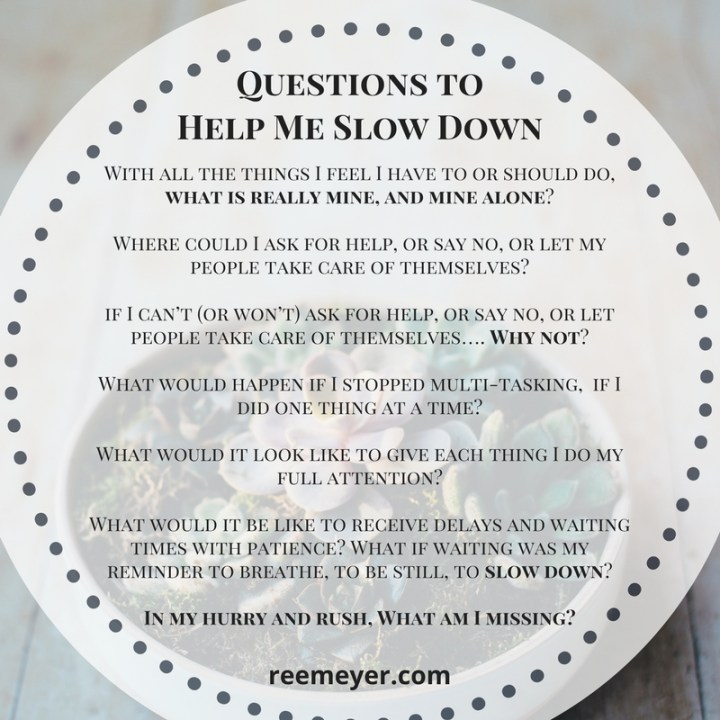
With all the things I feel I have to do, or should do, what is really mine, and mine alone?

Where could I ask for help, or say no, or let my people take care of themselves?

And if I can’t (or won’t) ask for help, or say no, or let people take care of themselves…. Why not?

What would happen if I stopped multi-tasking? Would life stop, would my family fall apart if I did one thing at a time?

What would it look like to give each thing I do, each person to come across my path, my full attention?

Life comes with built in slowness: Whether they are expected or come as a surprise, we all face delays and waiting in our days. Stoplights. Bathroom breaks. Waiting for the toast to brown, or the water to boil, or the kids to come running out of the school.

What would it be like to receive those delays, those waiting times with patience, as a gift? What if those waiting times were my reminder to breathe, to be still, to slow down?

Relationships (with God and our fellow men) require time and attention. It is so tempting to rush through all my time and never giving anything or any one my full attention. What am I missing?

“Be still, and know that I am God…” Psalm 46:10


Questions to help me slow down


Image used in photo by Annie Spratt on Unsplash

Surprised by Jesus

I spent the last 5 days with 124 amazing students, in the beautiful Rocky Mountains, talking about meeting God in ordinary and surprising ways. I got to lead a meditation on one of my favorite Bible stories…about a woman who went looking for Jesus but was still surprised by Him.

But as He went, the crowds were pressing against Him. And a woman who had a hemorrhage for twelve years, and could not be healed by anyone, came up behind Him and touched the fringe of His cloak, and immediately her hemorrhage stopped. (Luke 8:43-44)

In her culture, this woman would have been unclean, untouchable. I imagine she was lonely, and I am sure she dealt with shame.  In Mark’s account of this interaction, he adds the detail: “she had endured much at the hands of many physicians, and had spent all that she had and was not helped at all, but rather had grown worse…”

Lonely, ashamed, exhausted. Helpless and hopeless, she goes looking for Jesus.

And a woman who had a hemorrhage for twelve years, and could not be healed by anyone, came up behind Him and touched the fringe of His cloak, and immediately her hemorrhage stopped.

Matthew’s account tells us she thought to herself, “If I only touch his garment, I will be healed.” Helpless and hopeless, she goes looking for Jesus, hoping, expecting to be healed.

By Jewish law her uncleanness made her untouchable, but still she entered this pressing crowd (I picture it like leaving a Husker game where you’re pressed together like slowing moving sardines. By pressing in with the crowd, she made them all ceremonially unclean, something they surely would have resented.

This was a brave act, but she was desperate.

Where is the surprise in our story? She went into the crowd expecting that if she could just get near enough to Jesus she would be healed and she was. No surprise. Yet.

And Jesus said, “Who is the one who touched Me?” And while they were all denying it, Peter said, “Master, the people are crowding and pressing in on You.” (Luke 8:45)

Peter basically says, “Dude, everyone is touching you!”

But Jesus said, “Someone did touch Me, for I was aware that power had gone out of Me.”

When the woman saw that she had not escaped notice, she came trembling and fell down before Him, and declared in the presence of all the people the reason why she had touched Him, and how she had been immediately healed. (Luke 8:46-47)

This bleeding woman expected to touch Jesus and be healed.

But she WASN’T expecting to be noticed by Him.

She wasn’t expecting a personal encounter.

This woman wanted what Jesus had for her. But she wasn’t expecting Jesus to see her. She wasn’t expecting to be noticed.

She wasn’t expecting to have to tell her story. And she tells it publicly, in front all those people she made unclean. What is it about Jesus that made her brave enough to do that?

I don’t know for sure, but I do know what He said to her:

And He said to her, “Daughter, your faith has made you well; go in peace.” (Luke 8:48)


Can you put yourself in this woman’s place? Picture yourself, wading into a crowd of people around Jesus.

This woman had a hemorrhage, a 12 year health problem that had exhausted all of her resources. A great shame. Think of your own greatest shame. Your greatest need for healing. What do you want from Jesus?

Are you brave enough to push into the crowd around Jesus? Do you believe that He has what you need?

What do you need from Jesus? Picture yourself reaching out to touch Him, asking, needing, wanting.

Are you surprised that He sees you?

And friend, He DOES see you. You have not escaped His notice.

Picture Him, seeing you. Searching all the crowd for yours.

Are you afraid?

The woman was afraid, she came forward, trembling. I think she was terrified. She came trembling and fell down before Him.

Picture the expression on Jesus’ face as He looked down on her. What do you think she found in His eyes? Judgement? Condemnation? Disgust?

Or mercy? Kindness? Love.

To the woman’s great surprise, He called her daughter. DAUGHTER.

Picture yourself, trembling and terrified, bringing your shame, your hurt, your need before Jesus.

What do you see in His eyes, as He sees you? What does He say to you?

Can you hear Him calling you daughter? Son?

Jesus sees you. He calls you son, He calls you daughter.

Are you surprised?

Surprised by Jesus: A Devotional Meditation on Luke 8:43-48


Photo in my images by John Price on Unsplash

When You Don’t Really Slay at Life

I just finished listening to a podcast series celebrating women and it really bothered me. AT the end of every episode, every week: Unrest.

I love the podcast, I love women, I love celebrating women, and I personally celebrate a few of the women being interviewed, so what is my problem?

I’ve been working on the spiritual practice of noticing. Noticing my feelings, noticing my reactions, noticing my thought patterns. Not judging or evaluating, but noticing and asking God and myself: What is that about?

At least in part my problem is that as I listen to all  that these “Girl Bosses” have done with their lives, I can’t celebrate them because I’m busy comparing myself and not measuring up.

These business owners and world changers and over comers were also each introduced as “totally slaying.” Slaying at their jobs, slaying at ministry, slaying at life.

Am I slaying at life??

First: What does “slaying at life” mean anyway? Second: Is this, slaying at life, something I’m even called to?

I’m a hard worker and a grown up woman, and I’m doing the best I can with this life I’ve been given. If I feel like that’s not enough, like I need to be “slaying” at something, is that the voice of my Father?

Ultimately I wonder if my desire to “slay at life”, if my competitive reaction to the interviews I’ve been listening to, comes from my desire for greatness?

Make no mistake: I want to be great.

I’ve always been driven by success. I don’t always want to be the greatest, but I do want to be great. I think this is why fear of failure has bound me so tightly – I need to succeed. I listen to what other women have done, I hear them described as “slaying” and I want to slay at life.

So I turn (again) to what Jesus said about greatness.

 At that time the disciples came to Jesus and said, “Who then is greatest in the kingdom of heaven?”

And He called a child to Himself and set him before them, and said, “Truly I say to you, unless you are converted and become like children, you will not enter the kingdom of heaven. 

(Matthew 18:1-3)

Today I think I’ll lay down my desire to slay at life.

I’ll try to surrender my desire to succeed, to win, to be great. And I’ll look to the children in my life and learn Jesus’ definition of greatness.

When I look to children, I see:

Curiosity…

So I’ll foster a sense of wonder, and ask for eyes to see all that I don’t know. I’ll choose to be curious about others, about myself, about this wide, beautiful world we’re living in.

Trust…

So I’ll trust in the goodness of God and look for goodness in the world around me. I’ll try not to demand answers and explanations and understanding before I move forward, before I try, before I live.

Joy in simple things…

So I’ll rejoice in the simple sacraments of : Hands held around a table. Bedtime kisses on sleepy cheeks. Changing seasons. A favorite song.

Today I’ll lay down my desire to slay at life. I’ll  still be a grown up, I’ll expect to work and I’ll be responsible, and I’ll love excellence (because it’s the right thing to do, and also because that’s how I’m made.)

But I’ll also cultivate a childlike spirit, playful and curious and thankful.

I don’t always feel like I am slaying at life. But maybe that’s not the point, anyway.

When You Don't Really Slay at Life


Photo in my images is by Annie Spratt on Unsplash


When You Don’t Have What it Takes {A Devotional on the Feeding of the 5,000}

I’ve been afraid of not having what it takes as long as I can remember.

As a child I was desperately afraid of failure, of trying out for something and not making it, of being told “you’re not good enough.”

In a world where girls tell everyone who their crush is, hoping it will get back to him, I never told anyone who I liked. Because the idea of anyone knowing I liked someone who didn’t like me back felt like the end of the world to me.

In college I finally got brave enough to apply for things I wanted to do, but I never told anyone (so if I didn’t get it, no one would know I wanted it.)

In my twenties I missed (or nearly missed) job opportunities because I waited to be asked. I assumed that my desire to be included was understood by everyone, desperately afraid to communicate what I wanted for fear of not being chosen, being told I wasn’t good enough.

Even to this day I wonder if there are dreams, opportunities, hopes I won’t even admit to myself because of this fear of being told no, or WORSE, trying and failing, finding out once and for all that I don’t have what it takes.

It’s so much easier to stick with sure things, never admit what I want or need, never take on more than I can handle.

Do you relate?

I am helping lead a Bible study this Fall for a precious community of women who are studying the table scenes in the book of Luke, looking at the way Jesus treated and interacted with people. Our study is called “The Radical Hospitality of Jesus”, and I’m learning more every week how much more radical Jesus was than I ever realized.


Learning about the radical hospitality of Jesus is stretching my boundaries, stretching my understanding of God, pushing against my ideas about who is in and who is out. The radical hospitality of Jesus is making me uncomfortable.

Sometimes as Christians we can fool ourselves into thinking following Jesus is all rainbows and unicorns, that it will happen naturally, when we do what is most comfortable to us.

But when we look at the life of Christ in Scripture, we see a path we may not even want to follow, and that I certainly don’t feel equipped to follow.

 RADICAL Hospitality.

I see Jesus welcoming outsiders and social outcasts and I am overwhelmed. I can’t even manage to make time for my neighbors.

Jesus crossed political and economic and social boundaries and I can’t even handle following my crazy relatives on Facebook.

I do not actually have what it takes to practice the radical hospitality of Jesus.

Which is not a surprise to God AT ALL. He knows that sometimes the Radical Hospitality of Jesus will require more than we have to give.

Our passage this week is like a breath of fresh air.

Jesus took them away, off by themselves, near the town called Bethsaida. But the crowds got wind of it and followed. Jesus graciously welcomed them and talked to them about the kingdom of God. Those who needed healing, he healed.

As the day declined, the Twelve said, “Dismiss the crowd so they can go to the farms or villages around here and get a room for the night and a bite to eat. We’re out in the middle of nowhere.”

“You feed them,” Jesus said.

They said, “We couldn’t scrape up more than five loaves of bread and a couple of fish—unless, of course, you want us to go to town ourselves and buy food for everybody.” (There were more than five thousand people in the crowd.)

But he went ahead and directed his disciples, “Sit them down in groups of about fifty.” They did what he said, and soon had everyone seated. He took the five loaves and two fish, lifted his face to heaven in prayer, blessed, broke, and gave the bread and fish to the disciples to hand out to the crowd. After the people had all eaten their fill, twelve baskets of leftovers were gathered up. (Luke 9:11-17)

Of the 8 table scenes we’re discussing in our study, this is the only one where Jesus is actually the host. He’s welcoming the crowd, and ultimately He provides for them. But He invited the disciples to participate with Him in welcoming and providing.

Jesus is inviting them into the life of dependence that offers God our human not-enough, offers what we have to God with thanks and prayer, and sees Him bless, break and give.

I believe this miracle, this sign can be a way of life for us as well. A life of dependence on the Father that offers our not-enough and sees Him make it more than enough.

I don’t think God is calling us to live limitless, boundary-less lives. We have to say no, and we have to recognize our humanity. He is God, we are NOT. If I am the answer, then He’s not, and that is a problem.

On the other hand, I tend to look at what God is calling me to through the lens of my own resources.

Forget about big miraculous callings, just simple life and motherhood and being a wife and friend and person in this hurting world is more than my resources can take.

I don’t have the wisdom, I don’t have the energy, I don’t have the patience, I don’t have what it takes to be who God has called me to be in the world. I don’t have what it takes to practice the radical hospitality of Jesus.


Which is not a surprise to God AT ALL. He knows that sometimes the Radical Hospitality of Jesus will require more than we have to give.

BUT.

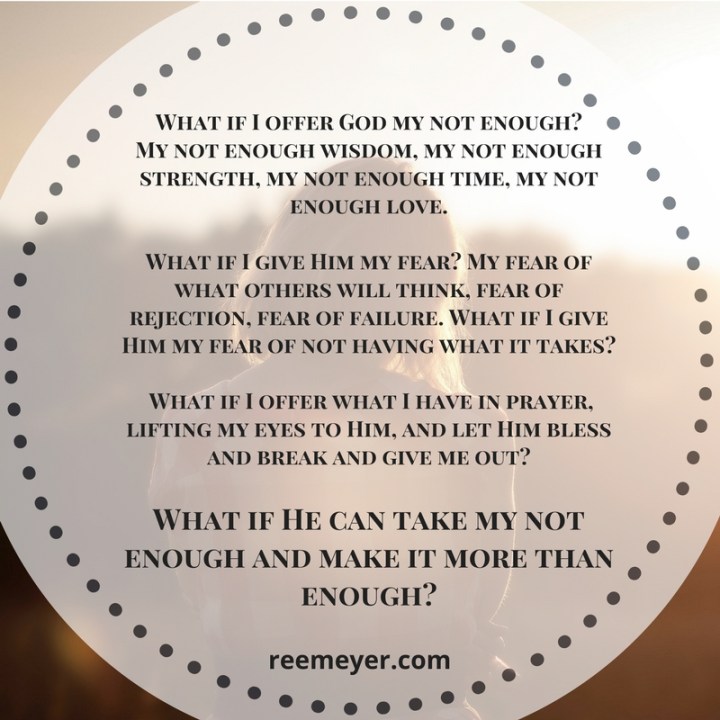
What if I do what the disciples do in this story: What if I offer God my not enough?

My not enough wisdom, my not enough strength, my not enough time, my not enough love?

What if I give Him my fear – fear of what others will think, fear of rejection, fear of failure? What if I give Him my fear of not having what it takes?

What if I offer Jesus just what I have, my own self. What if I offer what I have in prayer, lifting my eyes to Him, and let Him bless and break and give me out.

What if He can take my not enough and make it more than enough?


When You Don't Have What It Takes Insta Quote

I Will Be Satisfied.

In India this summer, I loved getting to meet people from various religions and learn what they believe and how that faith affects their lives. But I also loved and was greatly impacted by watching and learning from my Indian brothers and sisters, believers in Jesus.

One Sunday evening we had the opportunity to visit a small home-church gathering. This handful of  Indian Christians meet in an apartment in a part of town where very few Christians live, to sing, and pray and study the Bible together each week. It was beautiful.

A young man with a guitar led our singing, interrupting the songs periodically to pray. He thanked the Lord for His presence. For their American guests. For the gift of meeting together. For God’s Word and wisdom and guidance. For His goodness.

As he prayed and sang, this young man would periodically pause and say, Read more

I am a Shalom Sista

I’ve been thinking about the concept of peace for a long time.

In my family, peace was the absence of conflict, something you kept by not arguing, not rocking the boat.

In the Christian environment I was born into in college, peace was this magical quality that helped you make decisions. “I had a peace about it.”

Lovely, except that “not rocking the boat” can lead to enabling unhealthiness, and create more relational strain than an honest approach.

And for me, decision making is inherently un-peaceful. I literally have NEVER “had a peace” about a decision before it is made, because I fear making wrong decisions.

Thankfully, at some point in my twenties, I heard one of my favorite Bible teachers explain peace as the product of trust in God and submission to the Prince of Peace. “AHA!” I thought, “Finally, a peace that seems healthy and attainable for me.” And I still think true peace in my spirit comes first and foremost when I am trusting God and surrendered to His goodness, regardless of my circumstances.

But that definition of peace is limited to my own experience – I can trust and surrender to God’s goodness myself, but I can’t force it on others.  And as I continued to study my Bible, particularly the Psalms and New Testament Kingdom theology, I increasingly felt the need for a broader definition. A peace we can live out of, but also into.

I found it when I learned the concept of Shalom. The word translated peace in our English Old Testaments means wellness, completeness, safety, flourishing. 

This is what God is doing in our hearts and in the world, bringing Shalom. And this is what God is inviting us to join Him in: experiencing His shalom and carrying shalom into the world.

Read more

You are Invited.

As a young believer learning to share her God story, I was taught to describe the process of entering relationship with God as “inviting Jesus into my life.”

As a more mature believer teaching Sunday School and VBS, I’ve used the words, “Ask Jesus into your heart.”

Over these years of wanting more of God, asking Him to break out of what I think of Him and show me where my God view doesn’t match up with who He is in the Bible and reality, I’ve moved away from talking about relationship with God in this way.

I’m not sure I have a great suggestion for replacement words, but I have enough of an issue with the concept of inviting Jesus into my life/heart that I won’t use this wording with my own kids.

Because “I invited Jesus into my life” makes it sound like I initiated the relationship. It can fool me into thinking I made the first move. And however you want to describe the beginning of your relationship with Jesus, God went first.

We see this throughout the pages of Scripture: In the beginning, God… (Genesis 1:1)

This is the story for countless Old Testament Hebrews, some God-seekers like Abraham and Job, others running from God like Jonah and Jacob. Their stories begin  “Now the Lord said to Abram…” And “The Word of the Lord came to Jonah…”

It is no different in the Gospel accounts of Jesus’ life, where fishermen and tax collectors are minding their own business, doing their day jobs, and Jesus walks up and says, “Follow Me.”

I’m studying the story of Levi/Matthew’s calling this week, and I’ve been captivated by the first line:

After that He went out and noticed a tax collector named Levi sitting in the tax booth, and He said to him, “Follow Me.” Luke 5:27

He noticed a tax collector named Levi…

I spent years of my single life hoping to be noticed, longing to be chosen. I spend many of my hidden days, those family days no one sees, still longing to be noticed, wondering if what I do matters.

What does it mean to you that Jesus notices?

He noticed a tax collector named Levi…and He said to Him, ‘Follow Me.'”

The Message paraphrases “follow Me” as “Come along with Me.” Jesus’ notice is not limited to the Spiritual Elite. His attention is not reserved for those who’ve proven themselves, earned His favor.

Jesus’ invitation to live life with Him is given here to the tax collector. The rejected, the despised, the not-good-enough. The outsider.

What does it mean to you that Jesus’ notice of you is not something to be afraid of? That He’s not going to notice you and then find you not good enough?

Levi responds to Jesus’ invitation with a big YES: He walks away from his dishonest livelihood, his identity and his shame, and goes where Jesus goes.

And then Levi throws a big party for Jesus, and invites all his tax collector friends.

This is what we church people want from new believers, right? This is the perfect success story, something we could show  and celebrate on a Sunday morning video, a sinner who walks away from his sin, and introduces Jesus to all of His friends.

For all our strategies and programs, this process is usually a lot longer. It can take new believers years to turn away from their livelihood, identity and shame. And it can take even longer years before people learn (usually through some sort of “training”) how to share Jesus with their friends.

Maybe times have just changed. Maybe that’s just life, and it takes longer sometimes, and that is fine.

Or maybe it takes longer because we see ourselves as the ones inviting Jesus.

We don’t see Him noticing us. Choosing us. Welcoming us even as He knows our sin and shame. Inviting us into life with Him not in spite of these things, but because of His great love.

What does it mean to you that Jesus invites you, just as He invited Levi?

Does it change how you think of God to realize that He initiated relationship with you, that He always goes first?

He chose us in Him before the foundation of the world… Ephesians 1:4

You Are Invited IG