Free Bible Study Goodness

Popping in with a little bloggy business for you today. I wanted you to notice I have a new link up there ^^^ on my blog menu. See that? Where it says FREE BIBLE STUDIES AND RESOURCES?

FREE?

Why yes.

I’ve been writing Bible studies for over 10 years for my local church, through my role in the college ministry and women’s ministry. It is one of the joys of my chosen vocation.

And it is a never ending delight to my heart to get my studies into the hands of other churches and ministries. I’ve been asked for copies many times over the years, to be used by churches and groups in other towns, states, and even around the world. It makes me so happy!


One of the projects I am working on this summer is getting everything I’ve written ready to share here on the blog, so they will be more easily accessible. (Up until now, people have to email me and ask, then I send them a PDF of what I used, with all the dates and information from when I taught the study – so I’m cleaning all that up!)

Check back regularly and see what I have for you.

Or (even better!)  sign up for my email list, and I’ll let you know when I’ve added new resources!

Right now, there’s just one study on there and ready to be downloaded (free!): a 12 week study on the Sermon on the Mount, which has been one of the most impacting and challenging studies I’ve ever participated in. I’ve done it with a group of 20 or so college students, adapted it for all 200 in our college small group Bible study, and taught it as part of a Bible study with 40 women through our Tuesday morning Bible study. It is good stuff, if for sure the hardest Bible study for me to write (not because it is hard to understand, but it is super challenging to live.)

Coming soon:

Living on the Rock: Finding Security in an Insecure World (A 12 week Bible study on the character of God, focused on moving beyond just knowing the truth to applying and living in it day by day.)

The Call of Jesus: Making Room to Hear and Respond to Jesus In Our Busy Lives (An 8 week Bible study organized around different invitations Jesus made: Follow Me, Come to Me, Abide in Me, and more.)

Teach Us to Pray (An 8 week study of the Lord’s Prayer. In this topical study, each week focuses on one phrase of the prayer Jesus taught His disciples to pray.)

And more…

Bible Study Goodness


Hang on Tight {Psalm 44, part 2}

Last year our college ministry spent the summer in the Psalms, and our staff directional team took turns writing devotionals for each Psalm that we covered. While I am traveling and working on some long term projects this summer, I thought I’d share some of the devotionals I wrote. This one is on the second half of Psalm 44,  which you can read here.


On Tuesday we talked about finding the honesty – together as a community – to say things to God like, “it feels like you have rejected and forsaken us.”

As I watch the news – violence near and far, division of all types, anger, hate fear – I do sometimes feel like we are in God-forsaken times. And when I see that violence, division, anger, hate and fear in people who claim the name of Jesus, I just don’t know what to say. WHY does God stand by and let this happen?

Join me in asking Psalm 44 to be our tutor. I am looking here for what we can learn about what to do as a community when it feels like oppression is running rampant. Read more

When God feels far away {Psalm 44}

Last year our college ministry spent the summer in the Psalms, and our staff directional team took turns writing devotionals for each Psalm that we covered. While I am on vacation this summer, I thought I’d share some of the devotionals I wrote. This one is on the fist half of Psalm44,  which you can read here.

Psalm 44 is categorized as a corporate lament – it is an expression of grief or anger, written to be expressed by a community, an assembly, a people. I feel very free to express my grief and questions to God on my own, but I see an honesty in the Lament Psalms (this one in particular) that makes me uncomfortable. Expressing this sort of honesty in public spaces, as a part of worship, feels unimaginable.

The Psalmist knows God’s history of goodness.

O God, we have heard with our ears, Our fathers have told us the work that You did in their days, In the days of old. You with Your own hand drove out the nations…For by their own sword they did not possess the land, and their own arm did not save them, but Your right hand and Your arm and the light of Your presence, for You favored them. (v.1-3)

This is the story of my people, the Psalmist cries. Those who came into blessing and victory not by might or by power, but by God’s spirit. And we – the Psalmist asserts – we will be a people who follow in those footsteps.

You are my King, O God; Command victories for Jacob. Through You we will push back our adversaries; Through Your name we will trample down those who rise up against us. For I will not trust in my bow, Nor will my sword save me. (v. 4-6)

The people of God expected victory. They expected the same outcome as their forefathers. But this is not a victory song.

Yet You have rejected us and brought us to dishonor, And do not go out with our armies. You cause us to turn back from the adversary; And those who hate us have taken spoil for themselves.

You give us as sheep to be eaten And have scattered us among the nations. You sell Your people cheaply, And have not profited by their sale. You make us a reproach to our neighbors, A scoffing and a derision to those around us. You make us a byword among the nations, A laughingstock among the peoples.

All day long my dishonor is before me and my humiliation has overwhelmed me… (v. 9-15)

We went went out in the name of our God and we have been brought low. We are God’s people and now we are a laughingstock, a reproach to the world. Why? Look at the first word in each those verses. You. You. You. You. You.

That is some real talk.

The Psalmist is accusing God of unfaithfulness, of being the source of their downfall. Is it OK to say that to a God you believe is GOOD?

I believe in God’s goodness. I hold tightly to God’s goodness. Reading Psalm 44, I want the Psalmist to turn the corner, to say that in the end of the story his people got the same outcome as their forefathers, “But your right hand and your arm and the light of Your presence saved them, for You favored them!” I want to shed some eternal perspective on this psalm.

But this is not a victory song. At this point in the Psalmist’s journey, overcoming was not his story (yet.) So he accuses and complains and laments.

And God apparently did not strike the Psalmist dead. As far as we know from Scripture, there’s no correction, no consequence for accusing God of abandoning His people. In fact, this Psalm and many like it were encased in Hebrew canon and then passed into Christian Holy Word.

As I read Psalm 44, I wonder how God felt, hearing his people sing this song.

How would He feel now if I were to be honest about my response to bad news and the current state of the world? If I publicly expressed that it feels like He has abandoned us and is allowing His people to be a laughingstock and reproach among the nations?

How did God feel, and how would He feel now?

Mad? Disappointed? Wishing we had the eternal perspective to trust Him?

Maybe.

Or maybe God understands.

In His great heart of empathy and compassion, maybe God knows how far away He feels to us sometimes, as the result of the fallen world and the Genesis 3 knowledge of good and evil. Maybe His eternal heart has room for all of our pain and honesty and accusations.

Maybe this is the reason faith is required for relationship with God – not to earn eternity or grace from Him (as if we could earn anything). Maybe He knows that the realities of this fallen world make it awfully hard to trust a God who feels very far away sometimes.

Jesus on the cross echoes another lament Psalm, “My God, my God, why have you forsaken me?”

Maybe, when we’re honest, God cries with us and whispers, wait.


If you’re interested in reading any of the other Psalms devotionals from last summer (I was very impressed with my coworkers’ writing skills, I really enjoyed every one of these!), you can look around over here.

Psalm 22: Abandoned and Rejected (is not the end of the story.)

Last year our college ministry spent the summer in the Psalms, and our staff directional team took turns writing devotionals for each Psalm that we covered. While I am on vacation this summer, I thought I’d share some of the devotionals I wrote. This one is on  Psalm 22, which you can read here.

As someone who remained single until her mid-30s while living in a college ministry world of people who often married at 22, I developed a lot of wedding pet peeves. There’s a wide world of stupid things commonly said to single people of a certain age at weddings: “When is it going to be your turn?” “Always the bridesmaid, never the bride!” and my favorite, “How come you’re not married?” I was always tempted to pretend to start crying and say, ”I guess no one wants me!” (I am not brave enough for that – I just went with the awkward smile and shrug.)

Thoughtless comments are annoying, but what was communicated in wedding ceremonies themselves sometimes (unintentionally) hurt more: Stories of answered prayer, thanksgiving for God’s faithfulness, the idea that this bride and groom were receiving God’s greatest blessing because “it is not good for man to be alone” (Genesis 2:18). Sitting in wedding after wedding as a single woman who had long prayed and trusted God with her singleness, and who deeply longed for marriage and motherhood, all of that “glory to God” felt like salt in a wound. It made me cry out in my heart, “WHAT ABOUT ME?”

The memory of that pain gives me a tiny glimpse into the bitter lament that opens Psalm 22, a raw cry of pain. Read more

Psalm 18: Face Your Fears

Last year our college ministry spent the summer in the Psalms, and our staff directional team took turns writing devotionals for each Psalm that we covered. While I am on vacation this summer, I thought I’d share some of the devotionals I wrote. This one is on the second half of Psalm 18,  which you can read here.

After becoming a Christian halfway through college, I was introduced to the concept of getting out of my comfort zone. Fear has always been a big issue for me, and as a young believer I latched onto the idea of trusting God enough to try things that scare me.

As I approached my last summer in college, I had one PE requirement to fulfill. Since I have been deathly afraid of heights my whole life, I decided to take a class called Venture Dynamics – a “Challenge Ropes Course” class that’s still offered at my university, and is described as “designed to increase a student’s sense of personal worth and esteem, promote personal and group interaction, and develop an increased awareness of one’s physical self.” I had no idea how far out of my comfort zone this class would take me. Read more

Psalm 18: A Fire & Brimstone God?

Last year our college ministry spent the summer in the Psalms, and our staff directional team took turns writing devotionals for each Psalm that we covered. While I am on vacation this summer, I thought I’d share some of the devotionals I wrote. This first one is on Psalm 18,  which you can read here.

“I love You, O Lord, my strength.” 

The Lord is my rock and my fortress and my deliverer, My God, my rock, in whom I take refuge;

My shield and the horn of my salvation, my stronghold.

I call upon the Lord, who is worthy to be praised, And I am saved from my enemies.

Psalm 18 opens with a beautiful summary of David’s relationship to God, then moves in for a closer look at enemies and danger he faced. The picture the Psalm paints is of surging waters, a hunter’s trap. David found himself in danger that felt like being in a dry streambed during a thunderstorm, finding a wall of water raging toward you. Or like trying to choose your steps wisely while walking through a field of traps laid by hunters.

Do you relate to David? Have you ever found yourself in a physical or emotional situation that felt like a mine field, like danger is rushing toward you and there is no escape?

David’s response to this danger was to call upon the Lord.

In my distress I called upon the Lord, and cried to my God for help;

He heard my voice out of His temple, and my cry for help before Him came into His ears.

 When you cry out to the Lord, how do you picture Him responding?

To be honest, I sometimes picture God like a switch board operator, and I’m one of 8 million calls on hold. Or I see my prayer as a little wispy thing floating up to the invisible, hoping that it will be heard.

How would you expect God to respond to the danger in which David was in?

David describes God’s response to his cry for help using a poetic picture in verses 7 – 15: Then the earth shook and quaked; And the foundations of the mountains were trembling and were shaken, because He was angry. Smoke went up out of His nostrils, and fire from His mouth devoured; Coals were kindled by it…

The picture David paints is of an immediate response. And to be honest, it is a more violent response than I’d expect. Earthquake. Smoke and fire. Riding on darkness. Thunder, hailstones and coals of fire.

David – a military man, a commander and warrior before he even became king – presents a military picture of God’s response. This is literally a fire and brimstone picture of God.

Is this a comforting image for you? How does it feel to read this description of an angry God, coming on clouds of smoke and fire to lay bare the foundations of the earth?

I asked my Facebook friends what comes to people’s mind when they hear “fire and brimstone” and the responses were all negative. Judgment. Wrath. Shame. Fear. A God who is out to GET you.

I don’t like this view of God. Shame and fear have no place in a conversation about a God who went into death itself to rescue us from shame, fear, and the wrath of hell.

God is not out to get us.

So what do we do with the fire and brimstone picture of God in Psalm 18?

Look again at David’s situation. Imagine what it felt like to face such tremendous danger. What would it feel like to be so oppressed, hunted, surrounded…and then to see this God blazing toward you? To rescue you.

David isn’t painting a picture of a God who is out to get him.

His picture is of God coming TO him. God coming to rescue him.

Suddenly, the fire and thunder and immediacy of God’s response is a comfort. A reason for thanks and praise and celebration. Our God is a rescuer, and this psalm is a beautiful picture of His response to the injustice and evil that oppress.

Think about the danger and oppression – physical and spiritual – that you most dread. Picture your deepest shames, your greatest fears, the enemies of your soul surrounding you and closing in. Then read Psalm 18: 7-15 again:

Then the earth shook and quaked; And the foundations of the mountains were trembling And were shaken, because He was angry.

Smoke went up out of His nostrils, And fire from His mouth devoured; Coals were kindled by it.

He bowed the heavens also, and came down With thick darkness under His feet.

He rode upon a cherub and flew; And He sped upon the wings of the wind.

He made darkness His hiding place, His canopy around Him, Darkness of waters, thick clouds of the skies.

From the brightness before Him passed His thick clouds, Hailstones and coals of fire.

The Lord also thundered in the heavens, and the Most High uttered His voice, Hailstones and coals of fire.

He sent out His arrows, and scattered them, and lightning flashes in abundance, and routed them.

Then the channels of water appeared, and the foundations of the world were laid bare at Your rebuke, O Lord, At the blast of the breath of Your nostrils.

When you call out to God, is this how you picture Him responding to you, for you?

Can you see Him as a God who blazes to your rescue?

Do we believe that THIS is God’s heart toward those who are outcasts, endangered by the power structures in our empires? This is God’s heart for the oppressed. This is His promise:

He sent from on high, He took me; He drew me out of many waters.

He delivered me from my strong enemy, and from those who hated me, for they were too mighty for me.

They confronted me in the day of my calamity, but the Lord was my stay.

He brought me forth also into a broad place; He rescued me, because He delighted in me.

If you’re interested in reading any of the other Psalms devotionals from last summer (I was very impressed with my coworkers’ writing skills, I really enjoyed every one of these!), you can look around over here.

Better than Jesus? (Pentecost & the coming of the Holy Spirit)


We want a Jesus we can feel and see and touch, we want to know that He is with us. Over my years with college girls, I’ve lost count of how many have said to me, “I know God loves me, but I want something more. I want a love I can feel, arms around me, a hand to hold.” I have felt that myself.

And over the centuries, the words of Jesus echo

I am with you, always.

On Sunday the Christian church around the world will celebrate Pentecost, remembering the day the resurrected Christ fulfilled His promise to send a Helper, a means through which God’s people could live always with His presence.


The disciples had Jesus. The presence of God right in front of them. They could see, hear, touch God.

But Jesus said there was something better. Better than Jesus? Better than God right in front of them, God they could see with their eyes, touch with their hands, hear with their ears?

“I didn’t tell you this earlier because I was with you every day. But now I am on my way to the One who sent me. Not one of you has asked, ‘Where are you going?’ Instead, the longer I’ve talked, the sadder you’ve become. So let me say it again, this truth: It’s better for you that I leave. If I don’t leave, the Friend won’t come. But if I go, I’ll send him to you. (John 16:4-7, The Message)

Do we believe this? I see the promise right there in my Bible. But it doesn’t seem possible that what we have  is better than what the disciples had. Could it be possible that Jesus has kept His promise to be with us, always?

As we long for something more, something better, is it possible that we already have what we need?

Pentecost is not a holiday I have ever celebrated, never mentioned in my church tradition. And I wonder, why not? At Christmas, we celebrate God with Us. Through Lent and Easter, we meditate on what Jesus did on the cross. But Jesus Himself says something better is coming. Read more

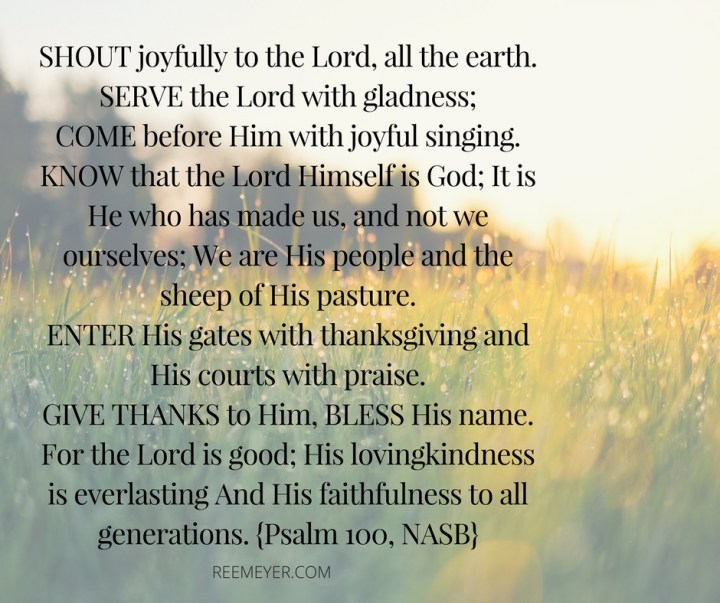
Sometimes you have to shout joyfully, even if you aren’t feeling it. {Psalm 100}

Sometimes you have to shout joyfully, even if you aren't feeling it.

When my kids are especially full of complaints I make them give me 5 things they’re grateful for, telling them “Thanksgiving is like magic, it makes the grouchies go away.” It worked like a charm on my oldest but the younger two are more resistant, determined to fight for their right to be in a foul mood (wherever could they get that from??)

I’ve been praying the Psalms as a spiritual habit for the past few months. I guess I’ve been doing it for the past 100 days, since I prayed Psalm 101 this morning. Though I’ve missed some days, and there were a few Psalms that spoke so directly and poignantly to my exact feelings that I stayed with them for a few days.

It has been a good and life-giving habit, celebrating the character of God and being honest about the realities of life. If I can pray the Psalm for myself and others as a “we” then I pray for us all. If I can’t relate at all to the circumstances of the Psalmist, then I think of someone or a group who could relate, and I pray for them. It has been stretching and good, teaching me to pray beyond my own present experience.

Most of the time this practice has stretched me toward praying for hard things I don’t often experience – enemies, the need for revenge, oppression. But this week I was unexpectedly stretched by Psalm 100.

Sometimes you have to shout joyfully, even if you aren't feeling it. {Psalm 100}

The 100th Psalm is a favorite favorite, a passage I’ve read and written and sung and taught and LOVED over the years. But yesterday I wasn’t feeling it. At all.

It was a tired Monday morning, I woke up with lots on my mind, and I wasn’t exactly in the mood to start my day by shouting joyfully to the Lord. I wasn’t really even feeling much like sitting joyfully in the Lord.

Psalm 100 is only 5 verses long, so I wrote out the words in my journal and made myself think about them. This song is a call to praise Yahweh, 7 commands in 5 verses:

SHOUT (Joyfully)

SERVE (with Gladness)

COME (with Joyful Singing)

KNOW (the Lord is God)

ENTER (His gates, His presence, with Thanksgiving and Praise)

GIVE (Thanks)

BLESS (His Name)

It wasn’t really in me in that moment to shout or sing joyfully, and I was feeling a bit resentful about serving with gladness. But in verse 3 I found something I could do:

Know that the Lord Himself is God, and we are His people and the sheep of His pasture.

So I stayed there for a while, knowing that the Lord Himself is God. And then I found that I could enter His gates (His presence) with praise, I could give thanks and bless His name.

In verse 5 we’re given the reason to answer these calls to praise:

The Lord is GOOD. His lovingkindness is everlasting and His faithfulness to all generations.

That is true truth, true on a grouchy Monday morning, true on good days and bad, true for the rich and for the poor, true for us all. The Lord is GOOD.

And I realized: I was grouchy because I was fighting battles in my mind that are not my battles to fight, fighting battles with people who are not my enemy (people who are, as Psalm 100 reminds me, His people and sheep of His pasture.) I had my eyes on little things rather than the one BIG thing (The Lord is GOOD.)

And as it turns out, Thanksgiving IS like magic. It chased my Monday morning grouchy away. I was able to enter my day with thanksgiving and serve with gladness.

Even I still wasn’t ready to shout.

Sometimes you have to shout joyfully, even if you aren't feeling it.


What does it mean to be a Christian? {Easter Thoughts}

Am I a Christian because I go to church on Sunday (and many of the other days)? Am I a Christian because of what I think about Jesus? Because I celebrate Christmas and Easter? Because I was raised to be a Christian? (I wasn’t, actually.)

I am a Christian because I believe Jesus is the Son of God, He is MY God. I have answered the great call to Follow Jesus. But as we slide down the last days of Lent into Easter weekend, I thinking about how easy it is for Christians to live as functional non-believers – myself included. We say we follow Jesus, but our lives bear no mark of Him. What better time than Easter weekend to contemplate what it really means to be a Christian, to follow Jesus.

Now before the Feast of the Passover, Jesus knowing that His hour had come that He would depart out of this world to the Father, having loved His own who were in the world, He loved them to the end. During supper, the devil having already put into the heart of Judas Iscariot, the son of Simon, to betray Him, Jesus, knowing that the Father had given all things into His hands, and that He had come forth from God and was going back to God, got up from supper, and laid aside His garments; and taking a towel, He girded Himself.

Then He poured water into the basin, and began to wash the disciples’ feet and to wipe them with the towel with which He was girded…

So when He had washed their feet, and taken His garments and reclined at the table again, He said to them, “Do you know what I have done to you? You call Me Teacher and Lord; and you are right, for so I am. If I then, the Lord and the Teacher, washed your feet, you also ought to wash one another’s feet. For I gave you an example that you also should do as I did to you.

Truly, truly, I say to you, a slave is not greater than his master, nor is one who is sent greater than the one who sent him. If you know these things, you are blessed if you do them. (John 13:1-17)

Jesus loved by lowering. John sees the love of Christ in the kneeling, serving Jesus. Jesus stripped, laying aside the garments of leader and teacher and taking the costume of a servant. Jesus washed even the feet of His betrayer, demonstrating love and service even for the hands that would slay Him. Read more

The Call of Jesus: Come to Me and find REST

“Come to Me, (JESUS SAYS) all who are weary and heavy-laden, and I will give you rest. Take My yoke upon you and learn from Me, for I am gentle and humble in heart, and you will find rest for your souls. For My yoke is easy and My burden is light.” (Matthew 11)

I have always understood this invitation “come to Me and I will give you rest” by itself, as if Jesus is saying “Come to me, TAKE A NAP. I’ll do everything else.” And Jesus has done it ALL. All our spiritual needs are met in Him. The search is over. When we find Jesus, we’ve found God. And there’s nothing wrong with a good nap.

But a spiritual nap is not what Jesus is promising here. Because to find the promised REST, we have to “take His yoke upon us and learn from Him”. Read more